


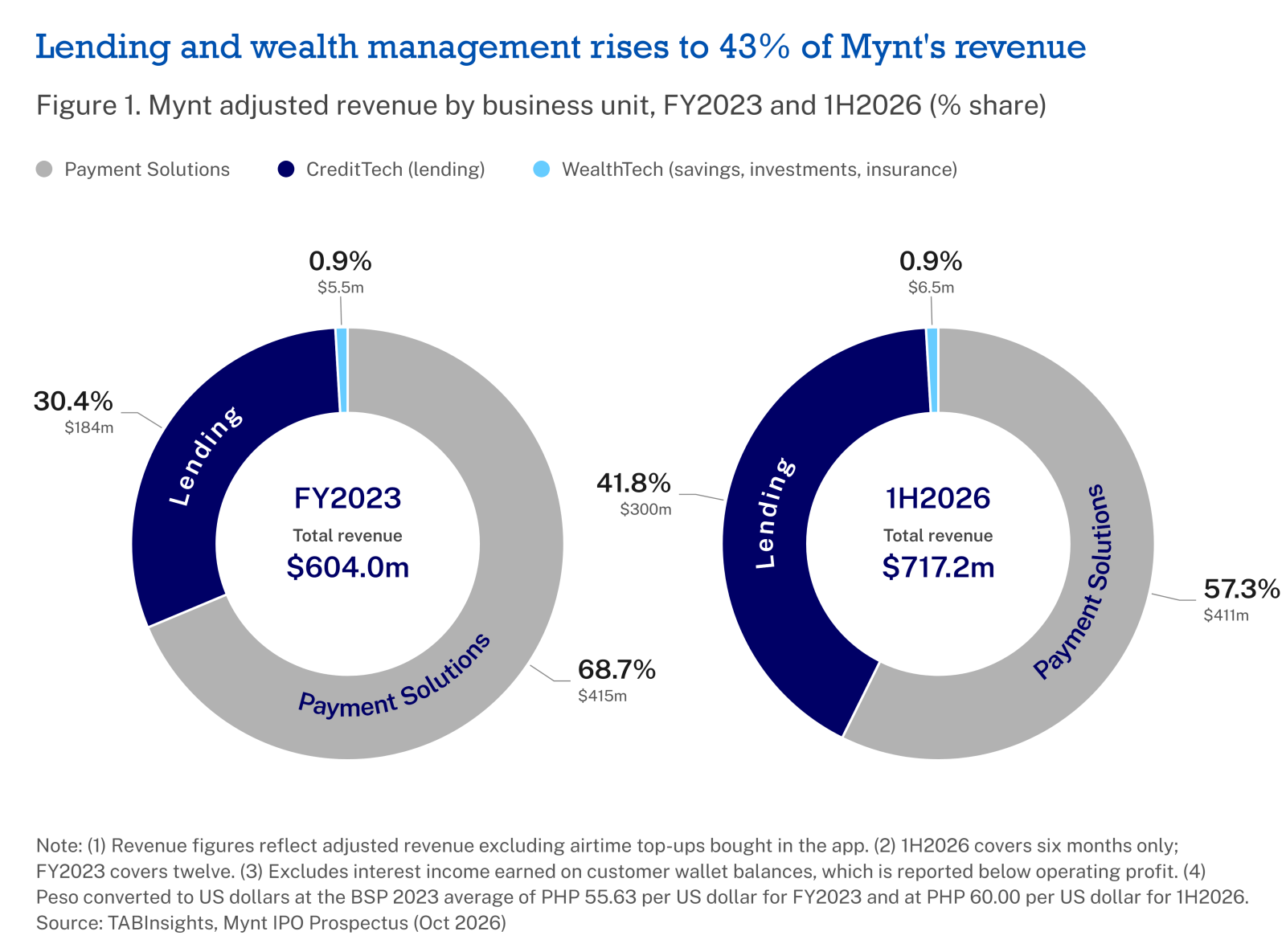
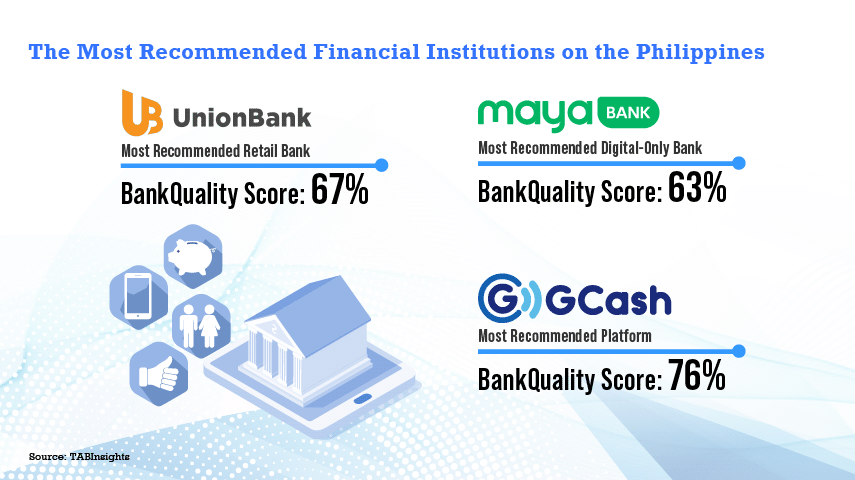
Mynt, the operator of GCash in the Philippines, is the country’s largest financial platform and e-wallet, built around payments serving 41.5 million active users monthly, more than half the country’s adult population. Customers use the app to pay bills, send money and top up phone credits. Its October 2026 IPO prospectus shows how far it has evolved from that origin (Figure 1). In 2023, payments generated close to 69% of revenue and lending 30%. By the first half of 2026, payments had fallen to 57% and lending had risen to 42%.
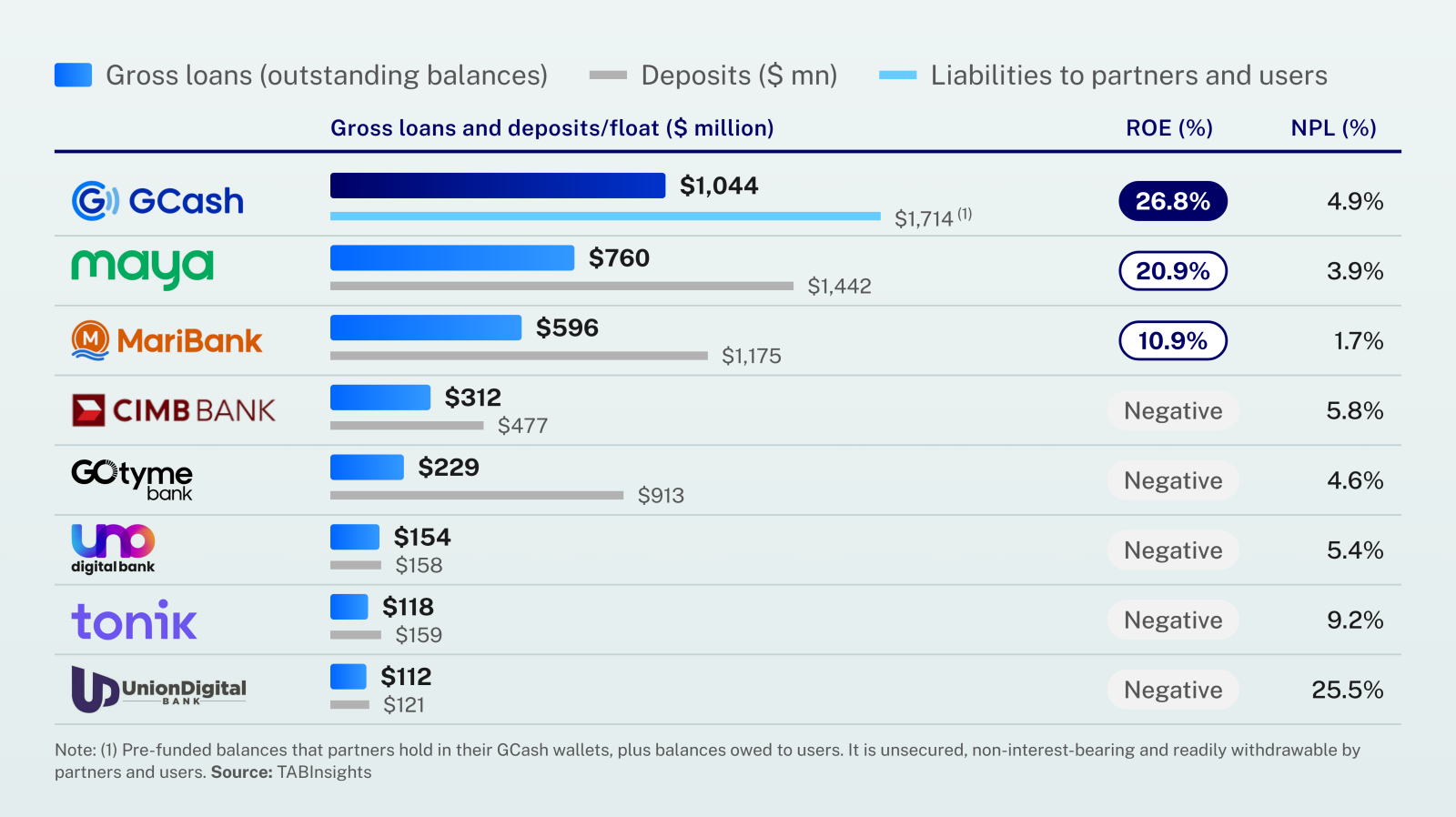
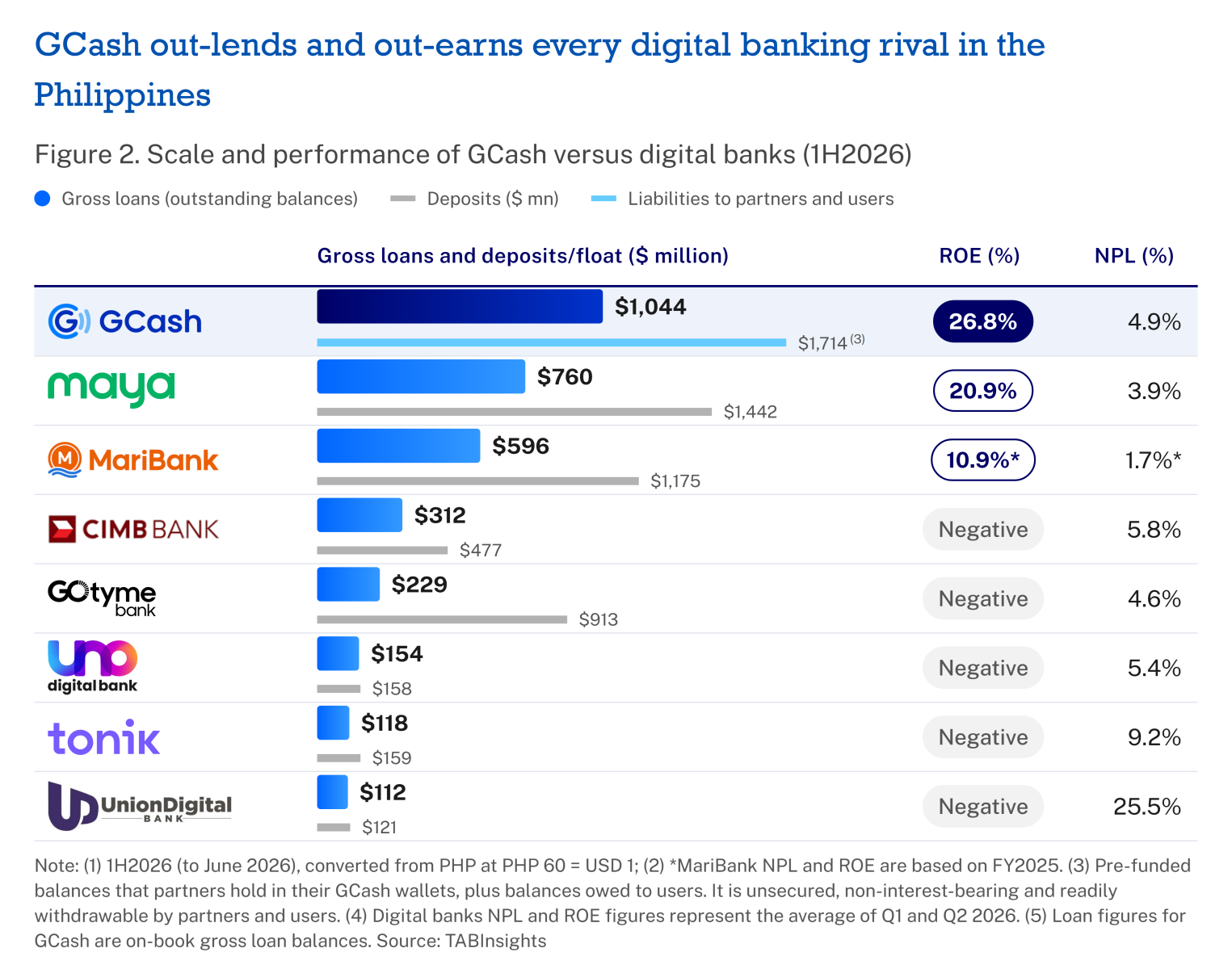
The balance sheet tells the same story. On one side is PHP 62.7 billion ($1.0 billion) of consumer loans. On the other are PHP 102.8 billion ($1.7 billion) in customer wallets and the pre-funded balances of payment partners, alongside PHP 23.3 billion ($380 million) borrowed from banks. Against those combined balances, Mynt holds PHP 78.8 billion ($1.3 billion) in trust accounts comprising cash and liquid assets, equivalent to about 77% of the total. Rules set by the central bank, Bangko Sentral ng Pilipinas (BSP), require at least half of all outstanding e-money to be held this way, a requirement that resembles the liquidity obligations banks face against deposits. It provisions for expected losses as a bank does, and earned a 26.8% return on equity, well above those of any Philippine digital bank, most of which still lose money.
Lending drives GCash’s growth, but credit risks are higher
GCash began offering formal credit in March 2018 with GCredit, a revolving credit line. In 2021 its lending arm added GGives, an instalment loan, and GLoan, a cash loan that was its largest product at the end of 2025. It also offers nano-loans (GLoan Sakto, from PHP 100 ($1.6)), prepaid and broadband credit through Borrow Load and loans to Lazada sellers.
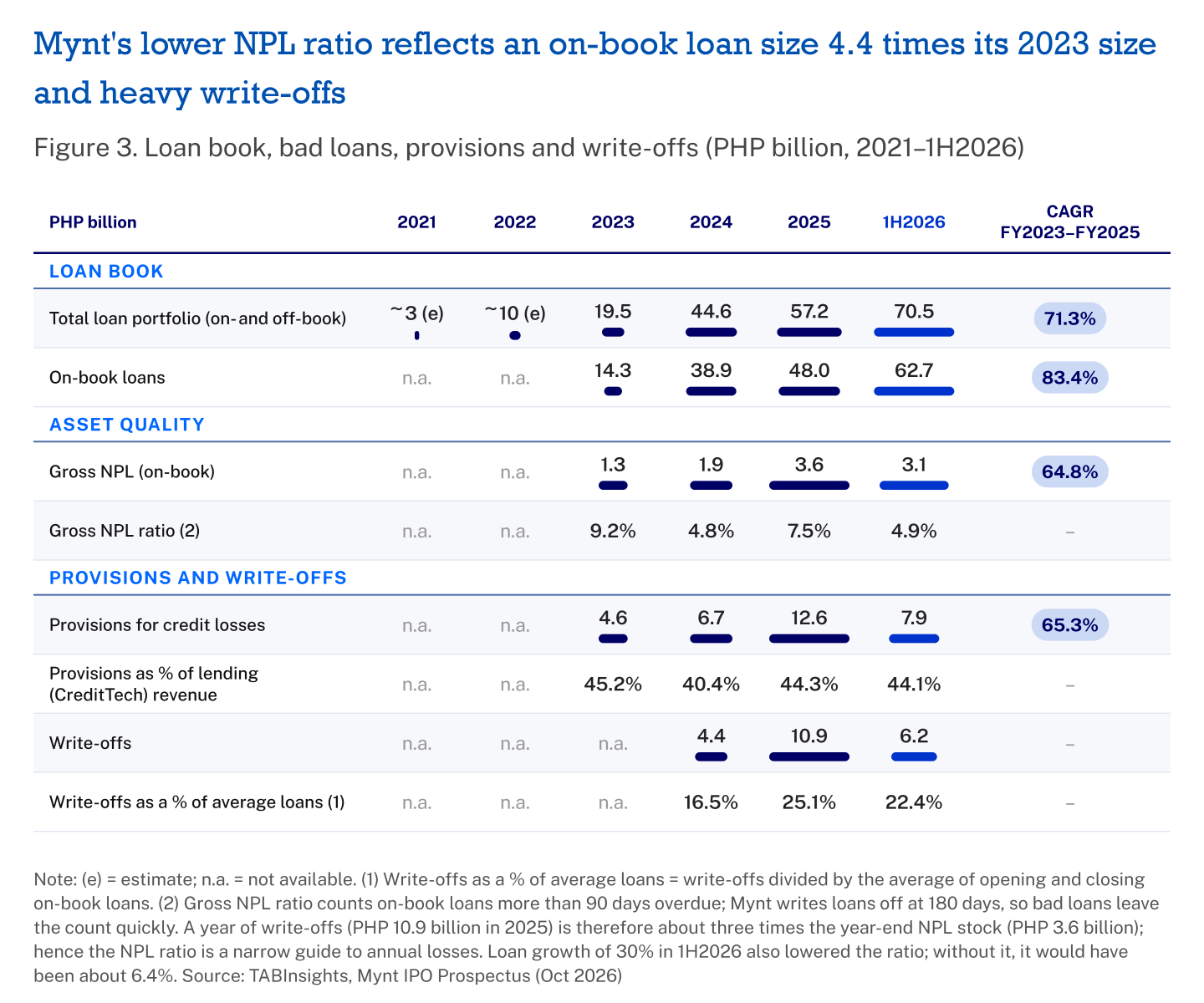
Mynt’s total loan book, including partner-bank originations, grew more than twentyfold in four years, from an estimated PHP 3 billion ($49 million) in 2021 to PHP 57.2 billion ($939 million) in 2025, before reaching PHP 70.5 billion ($1.16 billion) by June 2026 (Fig 3). Crucially, Mynt fully underwrites 89% of these loans. While pure-play platforms like Malaysia’s Touch 'n Go act strictly as a distribution layer for traditional banks, regional peers like Grab and Sea Group have absorbed credit risk by adding fully licensed digital banks to their platforms. Mynt occupies a distinct middle ground; it remains structurally a financial platform rather than a digital bank, yet manages its loan book internally, handles underwriting and retains most of the credit risk.
Mynt’s model is characterised by high interest rates and high-losses, with small, short-term loans targeting consumers rarely served by banks. This is also reflected in provisions, which absorb about 44% of lending revenue, while Mynt writes off roughly a fifth of its average loan book each year. Even after accounting for these losses and funding costs, however, it retains a net interest margin after losses of about 25% of loans.
Credit losses lag lending growth by a year
Since 2023, provisions have grown more slowly than loans, which could suggest improved underwriting at first glance. Between FY2023 and FY2025, loans on Mynt’s books grew at a compound annual rate of 83%, against 65% for provisions (Figure 3). The annual figures, however, reveal a different pattern. In 2024, the book almost tripled while provisions rose only 46%. In 2025, the pattern reversed. Loan growth slowed to 23%, while provisions rose 88% and write-offs rose more than doubled to PHP 10.9 billion ($178 million).
The losses, therefore emerged about a year after the lending growth. With new lending up a third in the first half of 2026 compared with the same period in 2025, the same lag points to further increases in provisions in 2026 and 2027. During the third quarter 2026 earnings call, management said it expected the non-performing loan (NPL) ratio to rise further, while describing the current ratio as near the lower end of its acceptable range.
The bad-loan ratio (gross NPL) reflects a similar pattern, falling to 4.8% in the 2024 boom and rising to 7.5% in 2025 (Figure 3). The 4.9% reading in June 2026 reflects the earlier lending boom rather than the subsequent deterioration. Underlying losses did ease in the first half of 2026, and each peak has been lower than the last, but the headline ratio is more likely to rise than fall once growth slows.
Half of the end of 2025 loan book consisted of borrowers acquired in 2024 and 2025, while active borrowers rose from 3.1 million at end-2023 to 7.3 million at end-2025. Many of the new borrowers were already GCash users, allowing their transaction histories to inform Mynt’s credit score. But the prospectus also describes nano-loans as a way to “the riskier segments”. The risk lies in a large pool of borrowers who have yet to complete a full credit cycle.
Mynt’s higher lending losses come with higher returns
A comparison with regional peer Grab Financial Services, although not directly comparable, highlights the difference in credit performance. Mynt’s provisions came to about 29% of its average on-book loans in 2025 and its write-offs to about 25% (?10.9 billion, $178 million), with similar annualised rates in the first half of 2026. Grab’s 2025 annual report shows its financial services arm recording provisions equivalent to about 12% of average gross loans and writing off about 7% ($69 million on a book of $1.28 billion), with a reported bad-loan ratio of only 1.6%. The two share one feature: write-offs in 2025 were roughly three times the year-end stock of bad loans (3.0x for Mynt, 3.5x for Grab), indicating that neither headline ratio adequately captures the scale of actual losses.
The gap in loss rates largely reflects differences in the underlying loan portfolios. Most of Grab’s book sits in Singapore and Malaysia, funded by deposits at GXS Bank and GXBank and partly made up of SME loans. By contrast, Mynt lends small, short, high-rate loans to Filipino consumers without a deposit base to fund them. Grab shows what the model looks like at lower risk and lower yield, yet its overall financial services segment still lost $110 million at the EBITDA level in 2025, compared with Mynt’s net income of about $282 million. Despite credit losses roughly three times higher, Mynt’s lending generates a return of about 25% of loans after funding costs and losses. This represents a risk premium rather than an inferior lending model, provided pricing continues to compensate for losses.
Mynt’s IPO prospectus does not disclose headline interest rates or annual percentage rates (APR) by product category, but it does provide a blended yield for the loan book. Mynt earned about 4.7% a month on its loan book in 2025, roughly 56% a year. The figure averages a wide range of products, from higher-rate nano-loans to larger GLoan and GGives loans, which carry lower for less risky borrowers.
Mynt’s funding advantage lies in customer data
GCash’s wallet balances exceed the deposits held by Maya Bank, the country’s largest digital bank. Unlike deposits, however, these balances cannot be used directly to fund lending; at least half must sit in trust, and users can withdraw at any time. Users earn no interest on them, but Mynt earns interest on the cash it holds, generating PHP 2.6 billion ($42 million) in the first half of 2026, equal to about 18% of pre-tax profit.
Equity and retained profits fund most of Mynt’s loans, with short-term bank lines covering just over a third. A further 11% of the portfolio is placed with partner banks, which generally take the credit risk while Mynt earns fees.
Mynt has an advantage over banks in collection and data. Almost all repayments flow through the GCash app, many before the due date, while the rest are deducted automatically from the wallet. The app’s behavioural and payments data also feeds its credit score. Traditional deposit funding does not replicate this advantage.
Without deposits, however, growth depends on equity, bank lines and partners’ willingness to take on Mynt’s loans, all of which come at a cost. Gross loans on its own books already equal 85% of equity, although Mynt still holds PHP 41.9 billion ($684 million) of corporate cash and has room on its bank lines. It pays about 6.3% a year on those short-term, unsecured lines, rising to about 8.3% once documentary stamp tax and VAT are included.
Return on equity has eased from 32.8% in 2024 to 26.8% in the first half of 2026, largely because equity almost doubled as Mynt raised capital and retained profits. The model can sustain high, if lower, returns. Loans passed to partner banks generate fees rather than lending margins but tie up little of Mynt’s capital. In addition, PHP 5.7 billion ($92 million) of IPO proceeds is earmarked for digital financial services growth. The real constraint for Mynt is neither funding nor funding cost but whether partners will keep buying loans from a book that writes off a fifth to a quarter of its value each year.
Will Mynt face bank-level regulation?
GCash’s margin after losses and its write-off rate are becoming more important measures of performance than transaction volumes or its headline bad-loan ratio. The Philippine experience also shows that a bank licence is not necessarily the decisive asset in digital lending; the customer relationship is. GoTyme, a digital bank, holds PHP 54.8 billion ($913 million) in deposits but lends only PHP13.7 billion ($229 million).
Bank-style discipline, meanwhile, is arriving before bank regulation does. Mynt’s lending arm, FUSE, is licensed by the Securities and Exchange Commission, not the BSP, yet its PHP1.75 billion ($29 million) three-year term loan from the Asian Development Bank (ADB) drawn in March 2026 to support small business lending, carries conditions resembling prudential requirements. Beyond a 5% return-on-assets floor, FUSE must hold tangible equity of at least 20% of managed assets, keep loans 30 days past due below 36% of equity plus reserves and cover at least 80% of short-term liabilities with liquid assets.
A lender of this size, writing off a fifth to a quarter of its loan book each year, could also face similar requirements from the BSP. GCash therefore faces a strategic choice: remain a non-bank, relying on wholesale funding and partner banks supply more of the balance sheet while retaining control of the customer relationship, data and repayment channel, or seek bank-like funding and accept bank-like regulation. In time, the BSP may conclude that a lender of this scale belongs inside the banking perimeter as a digital bank. The question is no longer whether GCash is a bank; economically, it increasingly is. The question is whether it can sustain bank-like returns without eventually assuming a bank’s capital and regulatory burden.
Subscribe for regular insights.






 Google
 LinkedIn