

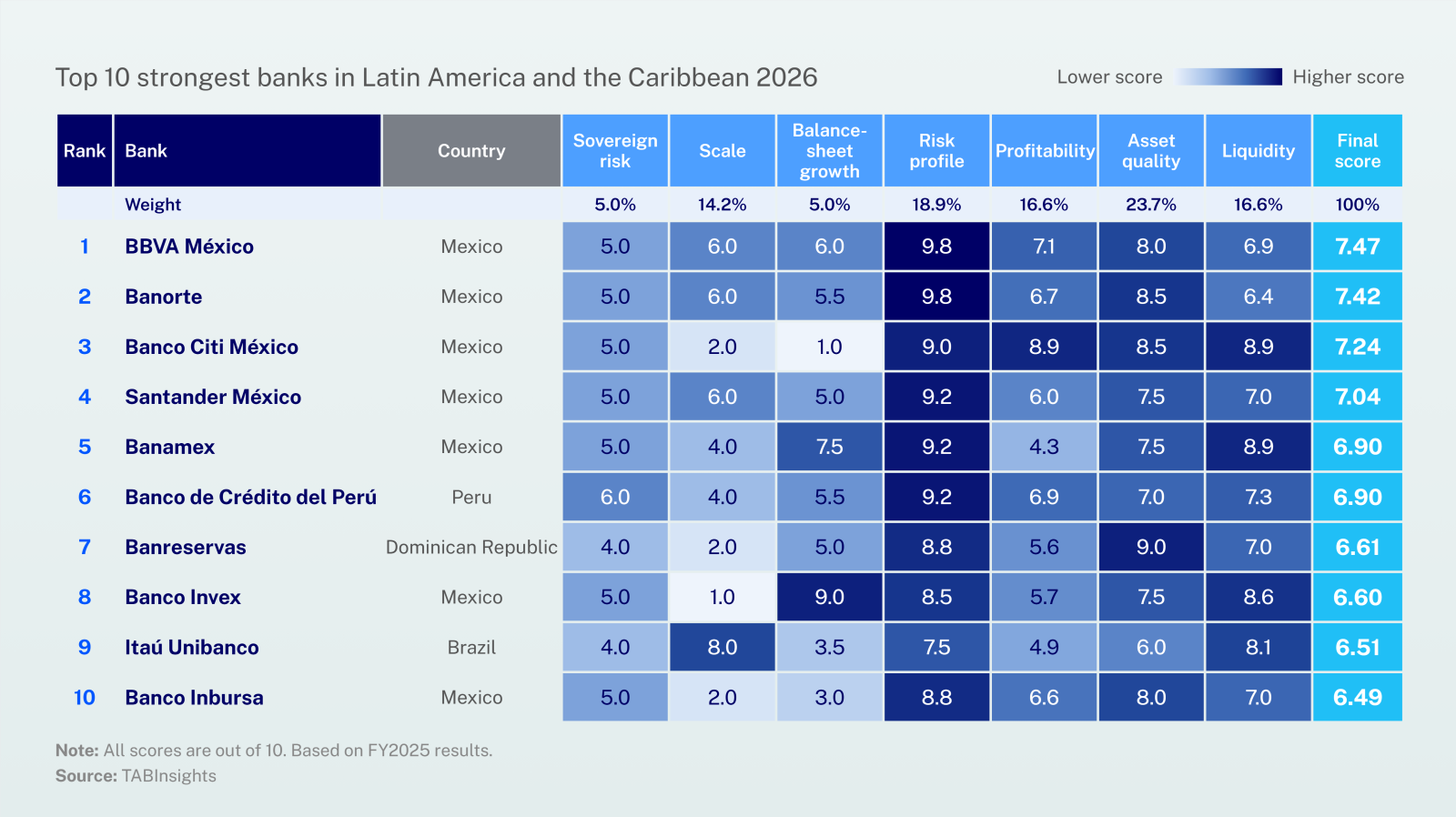

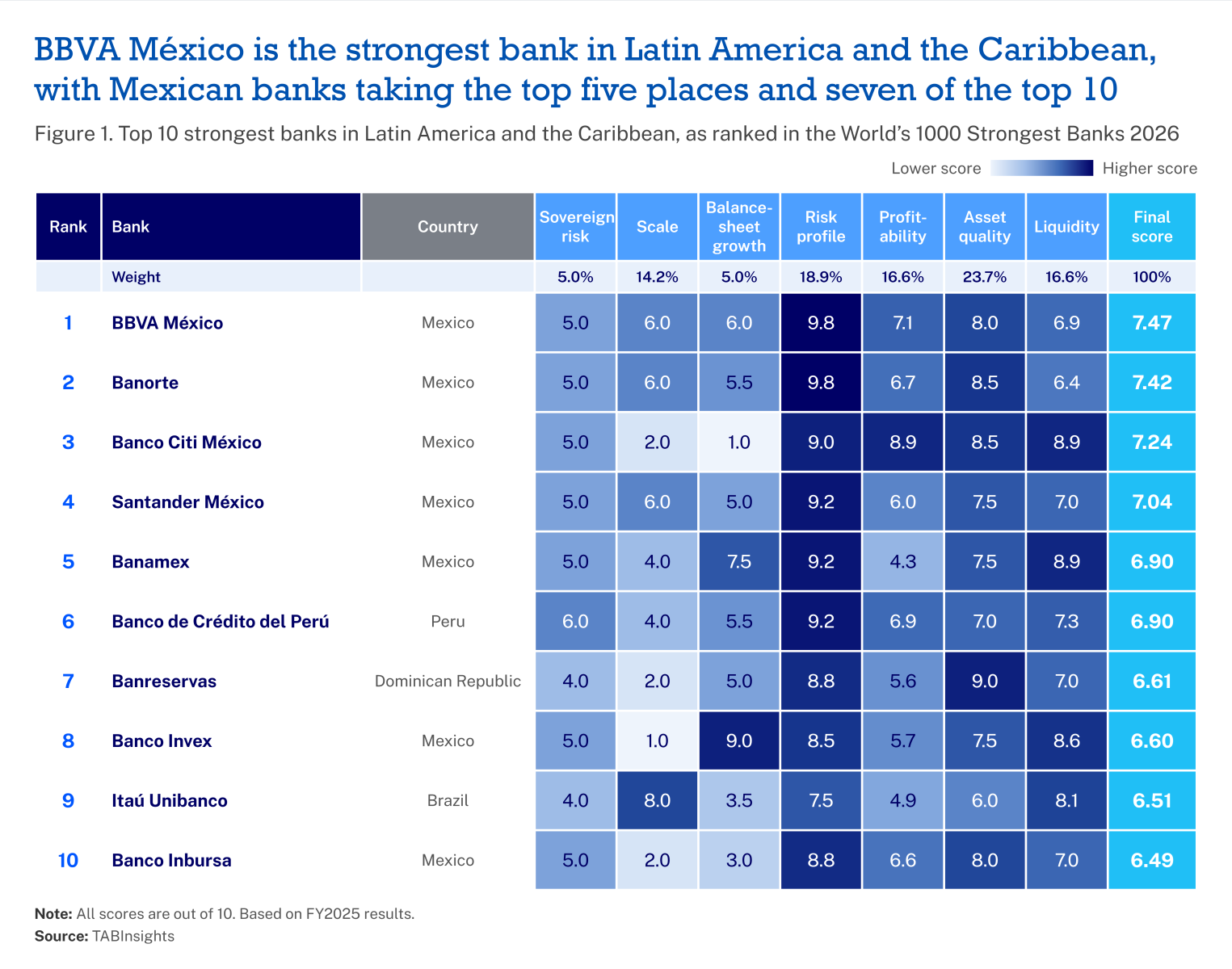
BBVA México leads Latin America and the Caribbean in the TAB Global 1000 World’s Strongest Banks 2026 ranking, followed by Banorte. Both banks combine established domestic franchises, strong profitability and resilient balance sheets, supported by disciplined credit management and solid capital positions. Mexican lenders dominate the regional ranking, occupying the top five positions and seven of the top 10. Banco de Crédito del Perú stands out as the highest-ranked bank outside Mexico, in sixth place, while banks from the Dominican Republic and Brazil complete the group, reflecting pockets of financial strength across the region.
Across the ranking's criteria, the 10 banks' clearest advantages over their regional peers lie in asset quality, capital and scale, while differences in balance sheet growth and sovereign ratings are small.
Of the 87 banks from Latin America and the Caribbean included in the ranking, the 10 strongest had a median gross non-performing loan (NPL) ratio of 1.83% in financial year 2025 (FY2025), compared with 3.82% for the remaining 77 banks. Their median loan loss reserve coverage was 177%, against 103%. Banreservas, which reported the lowest NPL ratio in the group, at 0.9%, held reserves covering more than four times its NPLs.
For Mexican lenders, regulation provides an additional factor supporting provisioning. Since January 2022, Mexican banks have applied regulatory accounting criteria aligned with IFRS 9, under which loan-loss allowances are based on expected credit losses. This framework requires earlier recognition of potential credit losses, supporting the accumulation of reserves before borrowers default.
Capital is another major source of difference. The 10 banks' median capital adequacy ratio was 20.0% in FY2025, compared with 16.0% for their regional peers. Their median Tier 1 ratio was 16.4%, against 13.5%. Regulation contributes to this position. Six of the seven Mexican banks in the top 10 are designated by the country's banking regulator, the Comisión Nacional Bancaria y de Valores (CNBV), as domestic systemically important banks. Under the CNBV's 2025 assessment, they face additional capital conservation buffers ranging from 0.6 to 1.5 percentage points. Stronger earnings also support capital accumulation. Higher returns and lower costs leave more income available to absorb credit losses and strengthen capital. Inbursa, the group’s most efficient bank, was also among its most profitable and best-capitalised.
Between FY2024 and FY2025, the 10 banks' median capital adequacy ratio rose from 18.7% to 20.0% and their median NPL ratio fell from 1.95% to 1.83%. Median reserve coverage eased from 190% to 177%, but remained well above the 103% recorded by their regional peers. In Mexico, where Banco de México lowered its policy rate from 10% to 7% over the same period, return on assets changed by less than 0.1 percentage points at five of the seven banks. Inbursa recorded a larger decline, while Banco Citi México moved from a loss to a profit.
Liquidity and funding provided further support. In FY2025, the 10 banks’ median liquid-assets-to-deposits-and-borrowings ratio was 38.8%, compared with 35.7% for their regional peers, and their real deposit growth was higher. Their median loan-to-deposit ratio was 86%, against 92% for the other 77 banks, indicating that deposits funded a larger share of their lending.
The comparison shows that asset quality, capital and scale are the main sources of strength among the 10 banks, with liquidity and profitability providing further support. In Mexico, where seven of the 10 banks are based, expected-loss provisioning and additional capital requirements for systemically important banks reinforce these financial positions. However, following Banco de México's further rate cut in November 2026, which brought its policy rate to 6.25%, sustaining profitability will be the next test. Broadening income beyond lending margins, which still account for most of their earnings, would help offset pressure on interest income while allowing the banks to preserve their capital and reserve buffers.
View the full ranking for the TAB Global 1000 World’s Strongest Banks.











 Google
 LinkedIn