

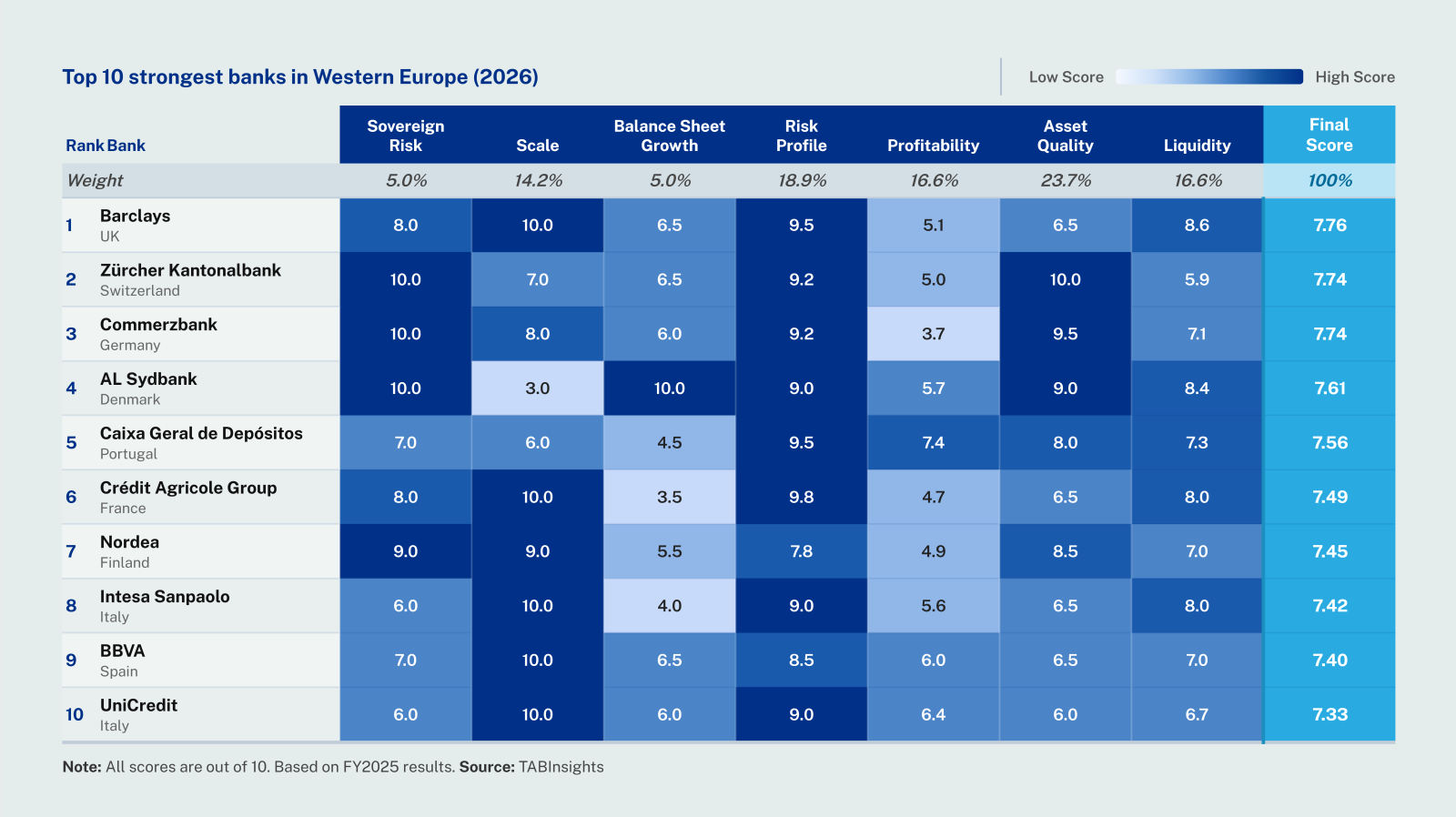

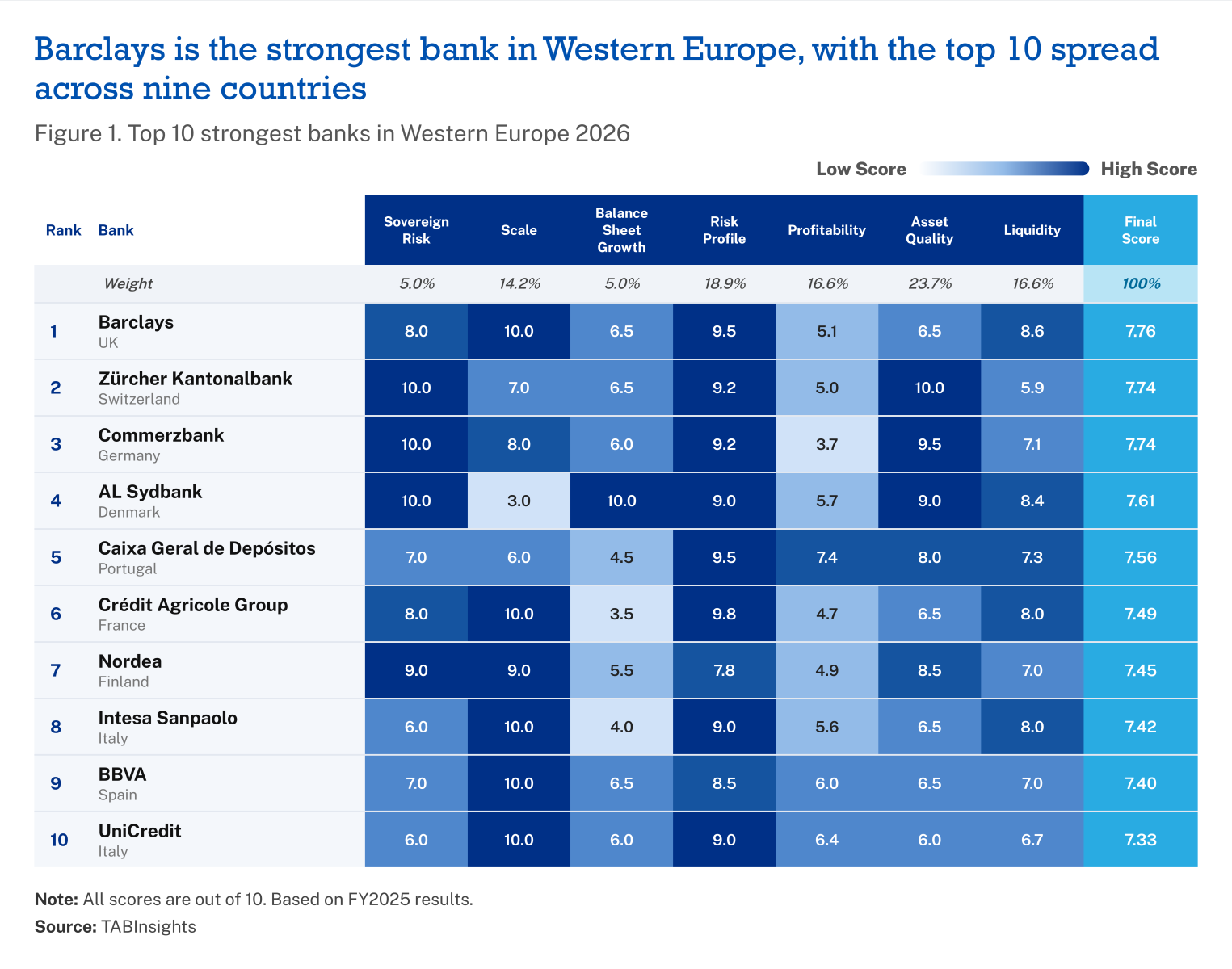
Barclays is the strongest bank in Western Europe in the TAB Global 1000 World's Strongest Banks 2026 ranking, followed closely by Zürcher Kantonalbank and Commerzbank. No single banking system dominates the regional top 10, which spans nine countries. For this analysis, Western Europe covers 163 ranked banks in 22 countries, from the UK and Ireland through the Benelux, German-speaking and Nordic countries to France and Southern Europe.
Capital strength is shared across the region. The 10 banks had a median capital adequacy ratio of 20.1% in financial year 2025 (FY2025), close to the 20.4% recorded by the other 153 banks in the region. Both figures were well above the global median of 16.4%. With capital levels broadly comparable, profitability and asset quality provide clearer points of differentiation between the top 10 and their regional peers.
The profitability gap is evident in both asset and equity returns. The 10 banks recorded a median return on assets (ROA) of 0.82%, against 0.63% for their regional peers, and a median return on equity of 12.2%, against 8.7%. Their median net interest margin (NIM) was 1.6%, compared with 1.7% for other banks in the region, indicating that higher lending margins did not account for their stronger returns. Instead, non-interest income and cost control played a greater role. Non-interest income accounted for a median 42% of operating income, against 30%, while the median cost-to-income ratio was lower, at 48%, against 55%.
Asset quality is another area of relative strength. The 10 banks had a median non-performing loan (NPL) ratio of 1.6% in FY2025, against 1.9% for their regional peers, while their loan loss reserves covered a median 84% of gross NPLs, compared with 61%. Between FY2024 and FY2025, the median NPL ratio for the 10 banks declined from 1.9% to 1.6%, with six reporting lower ratios.
Liquidity presents a more mixed picture. The 10 banks had a higher median ratio of liquid assets to deposits and borrowings, at 41.6%, against 22.9% for other regional banks. However, their regulatory liquidity ratios were lower. Their median liquidity coverage ratio was 143% and their median net stable funding ratio was 124%, compared with 181% and 135%, respectively, for other banks in the region. The gap partly reflects differences in bank size, and all 10 comfortably exceeded the 100% minimum for both ratios.
Within the top 10, profitability patterns differ between the four Southern European banks and the six from the UK, France, Germany, Switzerland and the Nordic countries. The latter are classified here as northern banks. The four banks with the highest ROA are all from Southern Europe: Caixa Geral de Depósitos, BBVA, UniCredit and Intesa Sanpaolo. Their earnings reflect wider lending margins and lower costs, with a median NIM of 2.2%, against 1.2% for the northern banks. Northern banks rely more heavily on non-interest income, which accounted for a median 47% of operating income, against 34% for their southern counterparts. They also reported lower NPL ratios, with the four lowest in the group belonging to Zürcher Kantonalbank, Nordea, Commerzbank and AL Sydbank.
This divide is also apparent across the wider region. Southern European banks recorded a median ROA of 1.07%, the highest among Western Europe's subregions, and a median NIM of 2.2%, against 1.3% elsewhere in the region. Banks in Germany, Austria, Switzerland and the Nordic countries had the lowest median NPL ratio, at 1.2%. Southern Europe accounts for 45 of the region's 163 ranked banks but seven of its 17 banks in the global top 100, despite generally lower sovereign ratings.
Western Europe's strongest banks combine higher profitability with better asset quality, but their earnings structures differ. Southern European banks rely more on lending margins and cost efficiency, while northern banks derive a greater share of operating income from non-interest activities and report lower NPL ratios, reflecting two distinct business models among the region's strongest banks.











 Google
 LinkedIn