

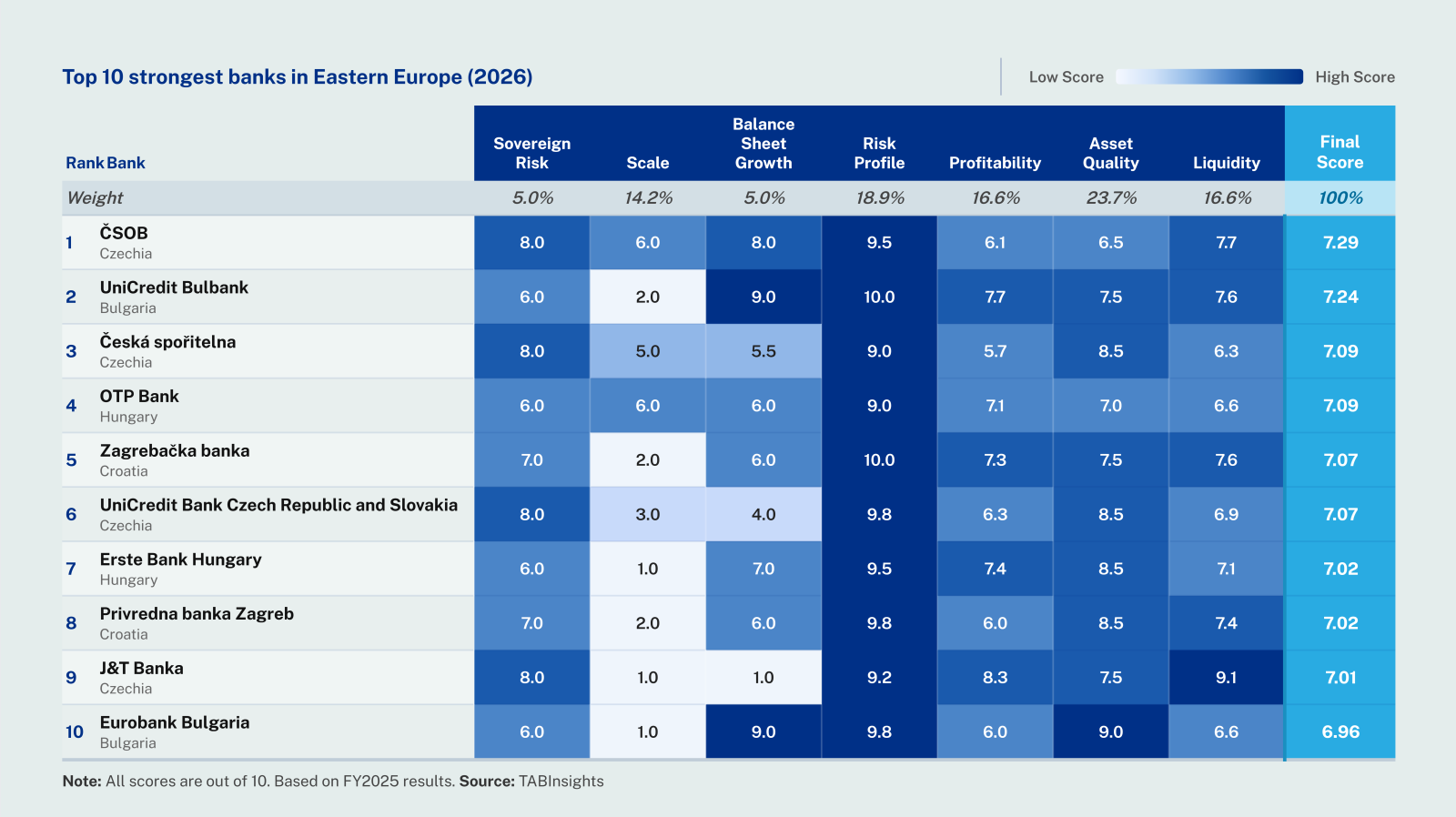

Ceskoslovenska obchodni banka (CSOB) is the strongest bank in Eastern Europe in the TAB Global 1000 World’s Strongest Banks 2026 ranking, followed by UniCredit Bulbank and Ceska sporitelna. Czechia contributes four banks to the top 10, while Croatia, Hungary and Bulgaria contribute two each. For this analysis, Eastern Europe covers 66 ranked banks in 13 countries, from the Baltic states and Central Europe to South-East Europe, Ukraine and Georgia.
Eight of the top 10 are subsidiaries of Western European banking groups. UniCredit owns three, Erste Group two, and KBC, Intesa Sanpaolo and Eurobank one each. The remaining two are OTP Bank, Hungary’s largest lender, which operates its own network of subsidiaries across the region, and J&T Banka of Czechia. The ranking generally excludes subsidiaries whose parent groups are already represented among the 1,000 banks, except where they are separately regulated and designated as domestic systemically important banks, or have a distinct statutory or systemic role. Each such subsidiary is assessed using its own financial statements and home-country sovereign rating, separately from its parent’s consolidated figures.
In financial year 2025 (FY2025), seven of the eight subsidiaries recorded a higher return on assets (ROA) than their respective parent groups. Erste Bank Hungary recorded an ROA of 2.9%, against 1.2% for Erste Group, while UniCredit Bulbank recorded 2.3%, against 1.3% for UniCredit. ?SOB also outperformed KBC, at 1.5% against 0.8%.
However, higher returns than their parent groups do not necessarily translate into a substantial profitability advantage over other banks in the region. The top 10 recorded a median ROA of 1.9%, against 1.7% for their regional peers, with both figures around twice the global median of 0.9%. Their median return on equity, at about 17.5%, was almost identical to that of the other banks.
Western European groups also own about half of the region’s other 56 ranked banks, including sister banks of the top 10 in Romania, Poland, Serbia and Slovakia. Group affiliation and profitability therefore provide only a partial explanation of the top 10’s stronger ranking positions.
Asset quality provides a clearer distinction. The top 10 had a median non-performing loan (NPL) ratio of 1.4%, against 2.5% for other banks in the region, while their loan loss reserves covered a median 124% of NPLs, compared with 92%. This difference widened further in FY2025. Between FY2024 and FY2025, the median NPL ratio for the top 10 fell from 1.7% to 1.4%, with nine banks reporting lower ratios. Among their regional peers, the median rose from 2.5% to 2.6%.
The difference persists within the same banking groups. The seven top-10 subsidiaries of UniCredit, Erste, KBC and Intesa Sanpaolo recorded the same median ROA as the 13 other subsidiaries of these groups in the ranking, at 1.6%. Their median NPL ratio, however, was 1.4%, compared with 2.5%. The same pattern is evident within individual groups. Erste’s two top-10 banks reported a median NPL ratio of 1.4%, against 2.6% for its four other subsidiaries in the region. UniCredit’s three top-10 banks recorded 2.0%, compared with 2.8% for its other regional subsidiaries.
Differences in national markets do not fully explain the gap either. Compared with the 19 other ranked banks in Czechia, Croatia, Hungary and Bulgaria, the top 10 had a lower median NPL ratio, at 1.4% against 2.5%, and higher reserve coverage, at 124% against 97%. The gap was evident in Czechia, Croatia and Bulgaria. Hungary was the exception, where OTP Bank’s NPL ratio of 3.2% was higher than that of most domestic peers.
The top 10 also achieved their returns with a more balanced earnings structure. Their median net interest margin was lower, at 2.6% against 3.2% for other regional banks, while non-interest income accounted for a larger share of operating income, at 34% against 28%. Their median cost-to-income ratio was also lower, at 42% against 46%.
Capital and liquidity provide additional support. The top 10 recorded a median capital adequacy ratio of 21.5%, compared with 20.3% for their regional peers, led by Erste Bank Hungary at 32.1%. Their median liquidity coverage ratio and net stable funding ratio were 177% and 157%, respectively. Although below the corresponding regional peer medians, both remained comfortably above the regulatory minimum of 100%.
In Eastern Europe, asset quality is a more significant distinguishing factor than group affiliation or profitability among the region’s 10 strongest banks and their peers. This difference persists in comparisons within banking groups and across most national markets.
View the full ranking for the TAB Global 1000 World’s Strongest Banks.














 Google
 LinkedIn