

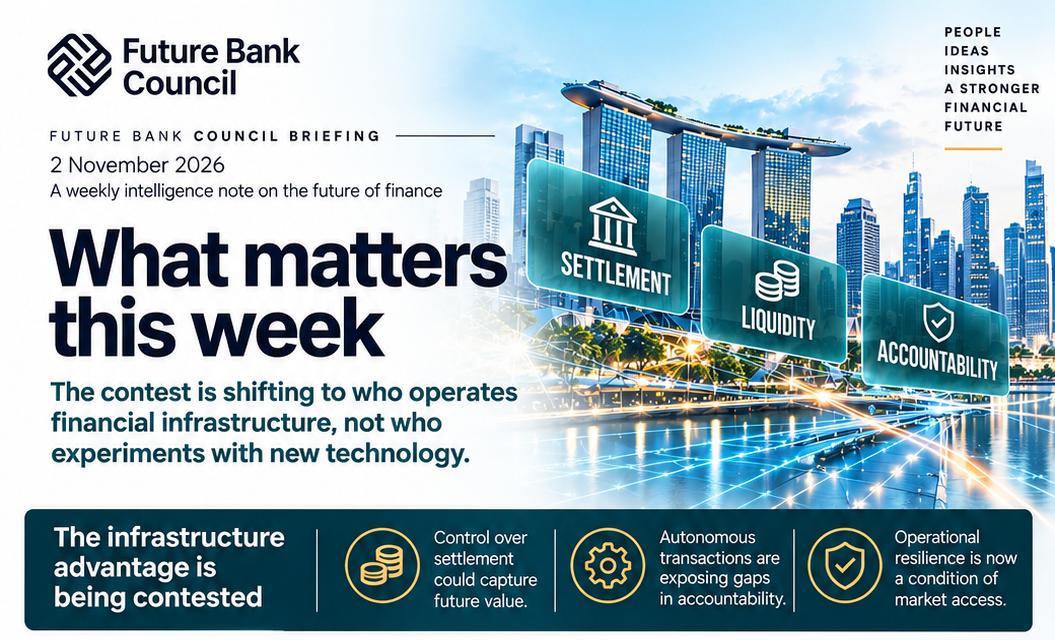

The infrastructure advantage is being contested
• Control over settlement could determine which institutions capture value from digital money.
• Autonomous transactions are exposing gaps in existing banking accountability.
• Operational resilience is becoming a condition of market access, not merely a compliance obligation.
Top stories
Central banks confront a new contest over payment infrastructure
Global | 29 October 2026
Private payment networks are changing the settlement question
The Bank for International Settlements (BIS) Committee on Payments and Market Infrastructures (CPMI) has examined central banks' changing roles as payment arrangements diversify.
Its report covers stablecoins, tokenised deposits, fast payment systems and programmable platforms. These arrangements create opportunities for competition while introducing new dependencies and risks.
Central bank money remains the anchor of trust
Fabio Panetta, governor of the Banca d'Italia and chair of the CPMI, warned: "Central banks cannot watch this frontier from a distance". The report identifies settlement-account access, infrastructure modernisation and oversight as areas requiring policy decisions. Private innovation still depends on confidence that different forms of money remain exchangeable at par.
Access decisions could redraw competitive boundaries
The question for banks is whether non-bank payment providers will eventually obtain settlement access on terms that narrow incumbents' advantages. Central banks face competing demands: wider access could encourage competition, while fragmented private networks could increase financial stability risks.
Where this leads
By 2030, broader settlement access could weaken banks' payment intermediation advantages while increasing the value of their liquidity services.
Hong Kong removes the overnight constraint on tokenised settlement
Hong Kong | 2 November 2026
Project Ensemble moves tokenised settlement beyond banking hours
The Hong Kong Monetary Authority (HKMA) has extended Project Ensemble to support round-the-clock interbank settlement of tokenised deposits using tokenised central bank money.
Participation now includes 12 banks and 20 industry pioneers. The pilot supports real-value transactions beyond conventional operating hours.
Corporate treasury becomes the commercial test
Eddie Yue, chief executive of the HKMA, observed that "Project Ensemble has transitioned from experimentation and piloting to a new phase".
The previous arrangement relied on Hong Kong's real-time gross settlement system. The extended capability can support corporate treasury transfers and transactions involving tokenised funds outside conventional settlement hours.
Continuous settlement challenges traditional liquidity management
Banks participating in Ensemble must examine how customers will fund transactions when ordinary money markets are closed. Treasury pricing, liquidity buffers and weekend operating coverage become commercial decisions rather than purely technical questions. Banks capable of supplying dependable liquidity could capture business from clients seeking continuous cash management.
Where this leads
By 2030, Ensemble participants could compete for cross-border treasury business through settlement availability and liquidity provision rather than payment speed alone.
The Bank of England makes liquidity under stress the test for tokenised collateral
United Kingdom | 29 October 2026
Tokenised collateral must meet existing clearing standards
The Bank of England has opened a consultation on supervisory expectations for central counterparties accepting tokenised forms of eligible collateral.
The Bank considers existing rules capable of accommodating such arrangements. Assets must remain capable of valuation, transfer and realisation, including during market stress.
Faster transfers do not remove collateral risk
Sarah Breeden, deputy governor for financial stability at the Bank of England, described the initiative as supporting innovation "while maintaining financial stability". Tokenisation could help firms mobilise collateral across jurisdictions. However, legal ownership, custody arrangements and the ability to liquidate assets remain essential when a clearing member defaults.
Operational speed matters only when assets remain usable
Clearing participants must establish whether tokenised securities provide the same enforceable rights and dependable access to value as conventional collateral. The consultation closes on 12 February 2027. Its conclusions could influence which digital collateral models gain supervisory acceptance.
Where this leads
Over the next three to five years, clearing arrangements unable to realise tokenised assets during stress could face restrictions despite faster settlement capabilities.
Europe's shorter settlement cycle accelerates the need for common market infrastructure
Europe | 29 October 2026
The 2027 deadline exposes outdated post-trade processes
European securities markets will move from two-day settlement to next-day settlement on 11 October 2027.
The European Central Bank (ECB) regards this as part of a wider effort to modernise European financial infrastructure.
Shorter settlement leaves less room for operational delays
Piero Cipollone, member of the ECB's Executive Board, warned: "Inefficiencies that could be accommodated in a T+2 environment will become much more difficult to sustain under T+1."
The Eurosystem is also developing Pontes, which connects distributed ledger platforms with central bank money settlement.
Banks need to connect two generations of infrastructure
Custodians and securities service providers face pressure to improve trade matching, funding and exception processing while supporting tokenised instruments. Separate operating models could create unnecessary costs and reconciliation risks. Common standards would allow established and tokenised markets to interact without duplicating every post-trade function.
Where this leads
The October 2027 transition creates a deadline for operational upgrades, while planned settlement enhancements could reshape Europe's post-trade services by 2030.
Hong Kong tests who is accountable when AI agents initiate financial transactions
Hong Kong | 2 November 2026
Autonomous transactions require new forms of authorisation
The HKMA has launched Project SAGE, or Securing Agentic Finance with Governance and Enablement.
The initiative examines artificial intelligence (AI) agents participating in consumer payments, business procurement, treasury management and machine-to-machine transactions.
Identifying customers no longer answers every question
Eddie Yue, chief executive of the HKMA, stated: "Agentic finance has the potential to transform how financial services are delivered and utilised." The project will examine agent identity, delegated authority, interoperability, legal responsibility and consumer protection.
Banks must distinguish permission from independent action
An authenticated customer may authorise an AI agent to make payments without approving every subsequent decision. That creates questions about transaction limits, revocation, records and liability. Banks need controls that distinguish an agent's identity from the authority granted to it. Conventional customer authentication does not resolve that distinction.
Where this leads
By 2030, financial institutions may need independently verifiable agent identities and delegated permissions before autonomous payment services become widely accepted.
Singapore centralises payment governance before its next infrastructure upgrade
Singapore | 28 October 2026
National payment schemes gain a common governing institution
The Monetary Authority of Singapore (MAS) and Association of Banks in Singapore have established the Singapore Payments Network (SPaN).
The organisation has appointed Derek Chan as chief executive officer and Jacqueline Loh as board chair. Operations are scheduled to begin in early 2027.
Governance consolidation precedes technical modernisation
Chan stated: "SPaN was established to consolidate the governance and development of Singapore’s national payment schemes."
An 11-member board will oversee the organisation, which will initially manage the transition from existing scheme administrators.
Common standards could change industry coordination
Singapore's banks and payment providers will depend on SPaN for scheme governance and future development decisions. A common governing body could coordinate infrastructure upgrades and regional connectivity more consistently. It also concentrates responsibility for decisions previously distributed across administrators. The immediate challenge is transferring these responsibilities without disrupting existing services.
Where this leads
By 2030, SPaN's governance model could provide a regulatory and institutional reference for countries seeking coordinated national payment infrastructure.
Hong Kong's quantum security toolkit exposes a measurable banking readiness gap
Hong Kong | 2 November 2026
Banks have a defined benchmark for quantum preparedness
The HKMA and Hong Kong University of Science and Technology have launched a post-quantum cryptography (PQC) toolkit.
The HKMA's Quantum Preparedness Index recorded an initial sector score of 2.3 out of 10. The authority aims to support progress towards a score of 10 by 2030.
The immediate challenge is identifying exposure
Arthur Yuen, deputy chief executive of the HKMA, identified the need to turn awareness into "clear responsibilities, informed priorities and practical plans".
The toolkit helps banks identify cryptographic assets, assess dependencies, engage suppliers and plan migration.
Legacy systems complicate the transition
A bank's cryptographic exposure extends across payment connections, outsourced technology, internal systems and third-party infrastructure. Many institutions must identify these dependencies before establishing realistic migration priorities. The HKMA's index indicates that Hong Kong's banking sector remains at an early stage. The timing of a practical quantum threat remains uncertain, making risk-based sequencing essential.
Australia expands payment oversight as merchant pricing comes under pressure
Australia | 28 October 2026
Payment reform is changing the economics of acceptance
The Reserve Bank of Australia (RBA) is examining payment arrangements beyond conventional card systems following an expansion of its regulatory powers.
Card surcharging was removed on 1 October 2026, alongside reduced interchange fee caps. The RBA is monitoring the impact on merchants.
Early evidence points to more price competition
Michele Bullock, governor of the RBA, reported: "several large providers have reduced their card processing fees for small businesses." The RBA also observed merchants comparing providers and receiving more competitive offers. Its broader review covers emerging payment models, including digital wallets and account-to-account payments.
A wider regulatory perimeter creates implementation risks
Payment providers must adapt pricing and disclosure practices while preparing for potential changes to oversight. Greater fee transparency could place pressure on acquiring margins. The review also raises questions about how the RBA will apply comparable regulatory expectations across different payment models. Australia expects further policy work in 2027.
Where this leads
By 2030, Australia could impose more consistent requirements across competing payment arrangements, challenging providers whose pricing depends on existing regulatory differences.
European AI spending raises questions about the quality of investment
Europe | 30 October 2026
Digital investment is taking a larger economic role
The ECB reports that euro area digital investment has risen by 73% in real terms since 2014.
Its share of gross domestic product increased from 2.3% in 2014 to an estimated 3.3% by the first half of 2026.
Spending on AI is influencing investment decisions
Philip R. Lane, member of the ECB's Executive Board, argued that AI adoption "will be a key determinant of European productivity growth in the coming years". An ECB corporate survey indicates that AI added approximately 10% to firms' capital expenditure plans this year. European financial institutions also provide funding to the global AI infrastructure buildout through banking and capital markets.
Banks must distinguish expenditure from productive capacity
Higher technology investment does not automatically produce stronger cash flows. Lenders need to assess whether borrowers are developing commercially useful capabilities or increasing costs ahead of uncertain returns. Concentrated technology exposures could also link credit risks across otherwise unrelated businesses.
Digital banking inclusion depends on infrastructure that banks cannot provide alone
Emerging markets | 20 October 2026
Digital access remains uneven across economies
The World Bank Group has launched a digital strategy covering connectivity, affordable devices and data, digital services and AI readiness.
The institution reports that more than two billion people remained offline globally in 2025. Internet use reached 23% in low-income countries, compared with 94% in high-income countries.
Digital finance cannot grow without basic access
Ajay Banga, president of the World Bank Group, argued: "Digital technology can help countries create jobs and make scarce resources go further." The strategy includes infrastructure and readiness initiatives focused initially on Africa and Latin America.
Distribution constraints can outweigh product innovation
Banks may develop low-cost digital financial services while potential customers lack affordable smartphones, connectivity or the skills needed to use them. The World Bank's approach highlights a constraint that banking technology investment cannot resolve independently. Market expansion may depend on collaboration with telecommunications providers, public institutions and infrastructure financiers. The counterintuitive implication is that better connectivity could create more banking opportunities than another mobile application.
Our view
We believe banks risk surrendering part of their competitive position if they continue treating settlement infrastructure, AI governance and digital assets as separate innovation programmes. The institutions that coordinate liquidity, operational controls and customer authority across these systems will have an advantage. Those that rely entirely on external platforms risk becoming distributors of financial products without controlling the infrastructure on which their services depend.
This does not mean every bank should build its own technology. Shared infrastructure can lower costs and improve access. The strategic question is which capabilities a bank must retain to protect its customer relationships and economics. A bank may outsource transaction processing, but it cannot outsource accountability for the liquidity it promises or the authority it grants to an automated agent.
We expect competition over the next three to five years to centre increasingly on settlement access, dependable liquidity and control over transaction permissions. Regulators will influence the boundaries, but banks will determine how much commercial value they retain within them. We believe institutions that establish these capabilities early will have stronger bargaining power as financial networks become more interconnected.
The decisive advantage in digital finance will belong to institutions that control the obligations behind the transaction.
Russell P,
TAB Global










 Google
 LinkedIn