

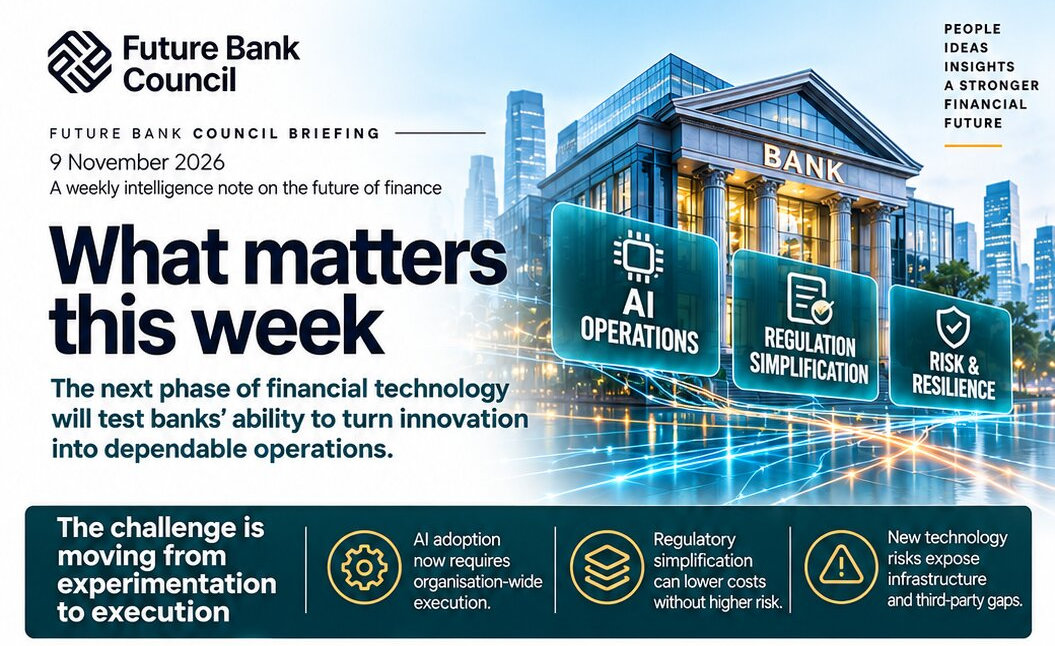

The challenge is moving from experimentation to execution
- AI adoption is becoming an institution-wide responsibility, requiring changes to data management, workforce capabilities and governance.
- Regulatory simplification is creating opportunities to reduce administrative costs without weakening risk management.
- New technology risks are exposing weaknesses in legacy infrastructure, third-party dependencies and customer protection.
Top stories
1. Singapore establishes a common framework for deploying AI in finance
Singapore | 3 November 2026
Financial institutions gain a shared platform for AI adoption
The Monetary Authority of Singapore (MAS) has announced that the Future of Finance Institute (FFI) has commenced operations, initially focusing on artificial intelligence.
The institute will coordinate industry work through three pillars: PathFin.ai for knowledge sharing, BuildFin.ai for developing capabilities and SafeFin.ai for strengthening risk management.
Common capabilities could reduce implementation costs
Chia Der Jiun, managing director of MAS, described FFI as a platform through which institutions can "pool expertise and collaborate in fast-moving technology areas such as AI".
The initiative will support practical deployment experience, common standards and risk-management approaches for emerging AI applications.
Shared standards do not eliminate institutional responsibility
Common implementation tools could reduce duplicated work, particularly for smaller financial institutions. However, banks remain responsible for determining which decisions AI systems can execute, how outcomes are monitored and when human intervention is required.
The commercial test will be whether collaboration produces measurable improvements in productivity, operating costs and customer service.
2. Bank of England demonstrates what institution-wide AI adoption requires
United Kingdom | 4 November 2026
AI moves from experimentation into everyday operations
The Bank of England has outlined how it is integrating data, analytics and artificial intelligence across the organisation.
Chief data officer Ben Martin reported that nearly all colleagues use Microsoft 365 Copilot weekly. The Bank has also developed specialised applications supporting internal knowledge retrieval, economic analysis and operational services.
Data foundations determine deployment success
Martin emphasised that "AI runs on data", identifying reliable information, governance and organisational capability as essential foundations.
The Bank is deploying an enterprise data platform, migrating legacy data services and applying its TRUSTED AI governance framework. Its dedicated learning function has delivered more than 250 courses covering data and analytical capabilities.
Technology adoption requires changes in how people work
The Bank's experience illustrates why providing AI tools is insufficient. Institutions must connect deployment with data ownership, employee training and redesigned processes.
For commercial banks, the challenge is translating widespread usage into measurable benefits. Adoption rates alone do not demonstrate improved decision quality, lower processing costs or stronger customer outcomes.
3. European banks face a smaller reporting burden but a new climate risk test
Europe | 9 November 2026
The EU cuts stress-testing data requirements by 55%
The European Banking Authority (EBA) has released the methodology and draft templates for its 2027 EU-wide stress test.
The exercise will require 55% fewer data points than the previous test, following changes to reporting templates and greater alignment with existing supervisory data.
The 2027 exercise will also introduce a dedicated module assessing physical and transition climate risks for the first time.
Supervisory simplification does not reduce risk expectations
The EBA intends to maintain the robustness and comparability of stress-testing results while reducing the administrative burden. The exercise will begin in January 2027, with results scheduled for publication by the end of July. The climate module will be separate from the core stress-test results.
Data architecture becomes a regulatory efficiency issue
Banks with integrated risk, finance and regulatory reporting systems could benefit more from simplified requirements than institutions maintaining fragmented data processes.
Reducing reporting volume does not remove the need for reliable information. It increases the importance of producing consistent data that can support several supervisory purposes.
4. Ireland warns that AI adoption is creating risks beyond individual institutions
Ireland | 3 November 2026
AI investment is becoming a financial stability concern
Gabriel Makhlouf, governor of the Central Bank of Ireland, has warned that rapid AI development is creating risks extending beyond individual technology deployments.
These include concentrated investment, debt financing, interconnected financial exposures and the growing capability of AI systems to influence financial transactions.
The central bank is examining how an AI-related financial market shock could transmit through the wider financial system.
Regulators are extending scrutiny from models to outcomes
Makhlouf stated that "technology neutral does not mean technology blind".
The Central Bank of Ireland has announced its next regulatory sandbox programme, Advancing AI for Consumer Good, with applications opening in January 2027.
The initiative will examine fairness in automated decisions, fraud prevention, support for vulnerable consumers and accountability as AI moves from advice to action.
External dependencies complicate accountability
Financial institutions increasingly rely on external AI providers while introducing autonomous capabilities into customer-facing processes.
Banks must understand how these dependencies affect operational resilience, decision-making authority and consumer protection.
5. European regulators strengthen board accountability while simplifying governance rules
Europe | 5 November 2026
The EBA revises internal governance requirements
The European Banking Authority has published revised guidelines on internal governance under the Capital Requirements Directive.
The revisions incorporate changes introduced by CRD VI, including clearer mapping of duties and responsibilities for management bodies and key function holders.
They also address organisational structures, conflicts of interest, internal controls and governance arrangements for third-country branches.
Simplification comes with clearer responsibility
The EBA aims to strengthen proportionality and reduce unnecessary compliance burdens without weakening governance standards.
The guidelines reinforce the need for institutions to identify who is responsible for critical decisions, how management functions interact and whether internal controls operate effectively.
Banks must demonstrate accountability through operating practices
For banking boards, the challenge is ensuring that governance responsibilities remain clear as business processes become more automated and technology services increasingly depend on third parties.
Simpler regulatory requirements may reduce documentation, but they do not eliminate the need for effective oversight.
The distinction between formal governance structures and actual decision-making becomes more important as institutions scale.
6. Singapore moves towards supervisory timelines for quantum-safe migration
Singapore | 6 November 2026
Quantum preparedness moves towards formal supervisory expectations
The Monetary Authority of Singapore has published a consultation proposing guidance and timelines for financial institutions to migrate towards quantum-safe cryptographic systems.
The proposed circular sets out supervisory expectations, including indicative milestones and completion timelines for preparing financial systems against future quantum computing threats.
The consultation closes on 23 November 2026.
Cryptographic migration becomes an enterprise-wide programme
Quantum preparedness requires institutions to identify vulnerable cryptographic technologies, understand dependencies across internal and outsourced systems and plan transitions without disrupting critical services.
MAS's proposal marks a progression from general preparedness discussions towards structured supervisory expectations.
Legacy infrastructure creates the greatest uncertainty
Banks depend on cryptography across payment systems, customer authentication, communications and third-party platforms.
Replacing these protections is not a straightforward technology upgrade. Institutions must coordinate changes with suppliers, assess interoperability and maintain service continuity throughout migration.
The challenge is establishing realistic priorities before quantum risks become an immediate operational threat.
7. European regulators question who is responsible for white-labelled financial services
Europe | 9 November 2026
Financial products are increasingly distributed outside banking brands
The European Banking Authority has published consumer guidance on white-labelled financial products and services, where a bank or payment provider supplies a product marketed under another company's brand.
These arrangements are becoming more visible as retailers, online platforms and non-financial companies distribute financial services.
The EBA warns that customers may not always understand which institution provides the underlying service.
Brand ownership and financial responsibility are becoming separate questions
The authority is encouraging consumers to establish who provides a financial product, which organisation is responsible for servicing it and where they can seek assistance.
The guidance highlights a structural challenge in embedded finance: the institution providing the regulated financial service may not own the customer-facing relationship.
Distribution partnerships create new conduct risks
Banks can expand their reach through commercial partners without establishing their own distribution networks.
However, unclear responsibilities could create problems involving customer communication, complaint handling and accountability when services fail.
The commercial benefit of broader distribution must therefore be weighed against reduced control over customer relationships and service quality.
8. India puts operational resilience alongside traditional banking risks
India | 9 November 2026
Digital growth increases the importance of institutional strength
Swaminathan J, deputy governor of the Reserve Bank of India, has called for banks to strengthen operational resilience alongside sustainable credit growth and sound governance.
Speaking at an Indian Bank leadership conference, he highlighted how digital payments, artificial intelligence and changing customer expectations are transforming the competitive environment.
He also identified the growing importance of technology infrastructure, cybersecurity, business continuity and oversight of third-party providers.
Technology reliability becomes a board-level responsibility
Swaminathan argued that "operational and technological resilience has become far more relevant".
His remarks emphasised that maintaining reliable financial services requires coordination across business functions and senior management, rather than treating technology resilience as the responsibility of specialist teams alone.
Growth without dependable operations carries greater risk
Indian banks are expanding digital capabilities while operating within increasingly interconnected financial and technology ecosystems.
A bank may strengthen its balance sheet and increase transaction volumes while remaining vulnerable to service interruptions, supplier failures or weaknesses in internal controls.
Sustainable digital growth therefore depends on whether technology infrastructure can remain dependable as business complexity increases.
9. Singapore creates new incentives for insurers to finance infrastructure
Singapore | 2 November 2026
Long-term capital allocation receives regulatory support
The Monetary Authority of Singapore has announced measures to encourage insurers to invest in infrastructure and securitised assets.
The package includes a S$30 million grant scheme to support infrastructure investment capabilities and proposed enhancements to the insurance capital framework.
The measures recognise the potential alignment between long-term investments and insurers' long-dated liabilities.
Risk-sensitive capital treatment could change investment decisions
The initiative reflects MAS's intention to distinguish more carefully between different investment risks while maintaining appropriate prudential standards.
Insurers could potentially become more important providers of capital for infrastructure projects and other long-term assets.
Banks face a changing institutional financing market
Infrastructure financing has traditionally involved banks, institutional investors and capital-market participants working across different stages of a project's life.
Greater insurance-sector participation could expand the availability of long-term funding.
For banks, this creates opportunities to originate, structure, distribute and service assets rather than retaining all exposures on their own balance sheets.
The commercial question is whether changes to capital treatment can attract additional investment without encouraging excessive risk-taking.
10. Italy warns that autonomous finance must preserve consumer control
Italy | 9 November 2026 publication
AI agents are creating a new consumer protection challenge
Sergio Nicoletti Altimari, deputy governor of the Bank of Italy, has warned that increasingly autonomous AI systems could introduce new risks as consumers delegate financial decisions and transactions.
In remarks delivered on 4 November, he described how AI agents could compare financial products, manage activities and initiate payments on behalf of customers.
However, a transaction executed within an agent's technical permissions may not reflect what the consumer actually intended.
Delegated authority must remain understandable and reversible
Nicoletti Altimari emphasised that "Delegating tasks to AI should not mean losing control".
Consumers must be able to understand an agent's authority, monitor its actions, challenge outcomes and revoke instructions.
Financial institutions must also maintain appropriate identity, consent, authorisation and audit controls.
Consumer protection becomes part of system design
Conventional authentication establishes who is accessing a service. Agentic finance introduces the additional problem of determining whether an autonomous action remains consistent with the customer's intention.
Banks may need more granular transaction permissions, stronger audit trails and accessible mechanisms for customers to intervene.
Protection must be embedded in the design of financial services rather than added after deployment.
Our view
We believe the banking industry is approaching a point where the quality of technology implementation will matter more than access to the technology itself. Artificial intelligence tools are becoming widely available, but their commercial value depends on the data, processes and institutional capabilities surrounding them. Banks that treat AI as a collection of separate applications risk increasing operational complexity without improving the economics of their businesses.
The Bank of England's experience offers a practical illustration. Broad adoption has required investment in data infrastructure, employee training and governance alongside access to new tools. Singapore's Future of Finance Institute suggests that some of these capabilities may increasingly be developed collectively. As common standards and implementation resources become more widely available, banks will have fewer opportunities to differentiate themselves simply by acquiring technology. The advantage will lie in how effectively they integrate it into their operations.
Regulatory developments reinforce this shift. Europe's efforts to simplify supervisory reporting and governance requirements demonstrate that reducing administrative burdens need not weaken accountability. At the same time, Ireland's examination of AI-related financial risks and Singapore's proposed quantum-safe migration requirements show that institutional responsibilities are expanding. Banks must manage technology and financial risks across increasingly complex internal systems and external dependencies.
We also see a significant change in the relationship between financial institutions and their customers. White-labelled financial products and autonomous AI services are creating new forms of intermediation in which the organisation providing the financial service may no longer control the customer's interaction with it. This creates opportunities for distribution and efficiency, but also raises questions about authority, responsibility and the ownership of customer relationships.
For boards and senior management, the priority is to ensure technology investment strengthens the institution rather than creating another layer of complexity. This requires dependable enterprise data, measurable operating outcomes, clearly assigned responsibilities and the ability to maintain customer trust as services become more automated.
Over the next three to five years, we expect competition to increasingly distinguish banks that can integrate new capabilities into dependable operating models from those that remain dependent on fragmented systems and isolated technology investments.
The next competitive advantage in banking will come not from having the technology, but from knowing how to operate it.
Russell P
TAB Global












 Google
 LinkedIn