
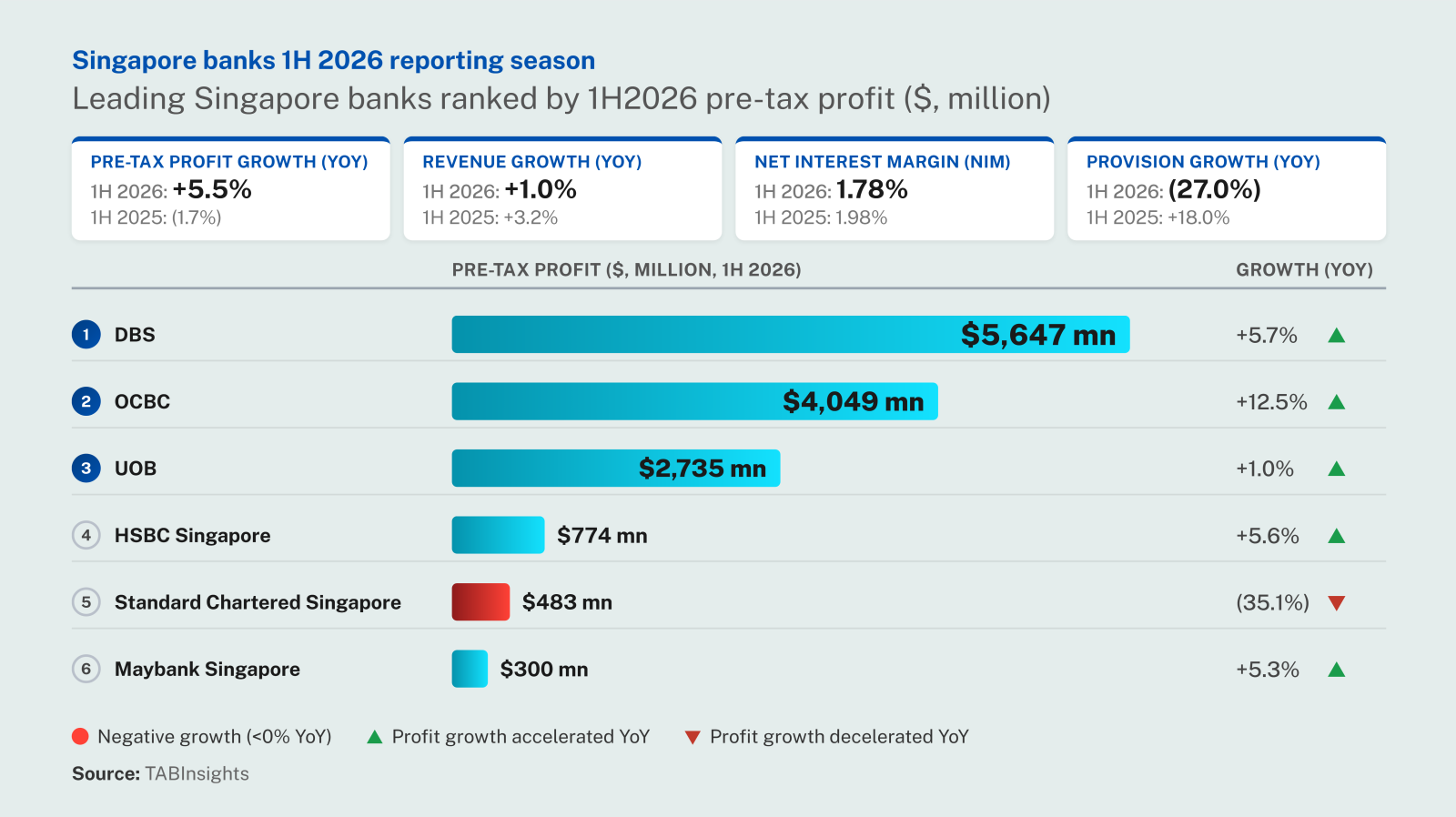

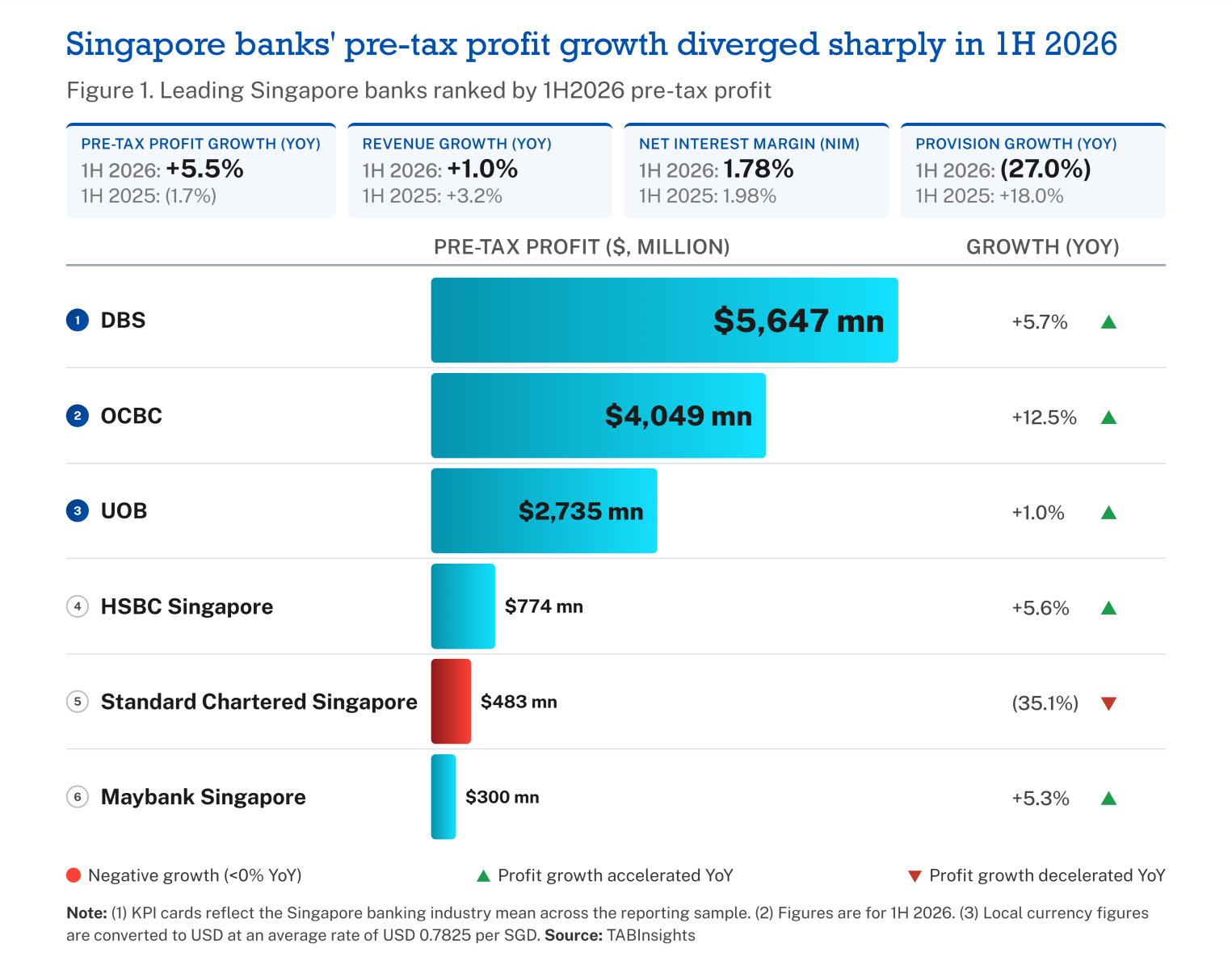
Across DBS, OCBC and UOB, earnings resilience came from different combinations of fee growth, loan expansion and lower credit costs, with no single lever driving performance across all three banks.
Wealth income tracks assets under management and market activity, card income faces structural interchange pressure, loan-related fees are dependent on deal timing, while transaction banking provides more recurring customer-flow revenue. How each bank converted non-interest income growth into earnings, rather than the pace of growth alone, determined the outcome.
Against this backdrop, group net interest margins narrowed across DBS, OCBC and UOB as lower interest rates reduced asset yields across their regional franchises. DBS, OCBC and UOB reported net interest margin (NIM) declines of 20, 25 and 18 basis points respectively, although loan growth provided different levels of support. The decline reflected lower interest rates across their key operating markets, including declining Singapore Overnight Rate Average (SORA), which influences funding and lending conditions in one of their largest markets.
OCBC delivered the strongest performance of the three, with pre-tax profit up 13% to SGD 5.2 billion ($4 billion) and return on equity (ROE) improving to 14%. Pre-provision operating profit also rose around 12%, and total income grew 11% to SGD 8 billion ($6.2 billion). Non-interest income rose 36% to a record SGD 3.5 billion ($2.7 billion), lifting its share of total income to 44% from 36% a year earlier; cost-to-income ratio improved to 38.5% from 39.1% on stronger revenue rather than cost cuts. Net fee income rose 26% to SGD 1.4 billion ($1.1 billion), with wealth fees increasing 39% and customer-flow income rising 47%. However, the increase in non-interest income was not driven entirely by recurring fees. Net fee income accounted for SGD1.4 billion of the SGD3.5 billion total, while the remainder included contributions from treasury, markets, insurance and other non-fee income sources.
OCBC’s broader revenue mix provided resilience, although the sustainability of these contributions will depend on market conditions and the continued strength of recurring customer-flow businesses.
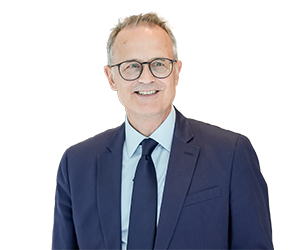
Loan growth was also the strongest of the three banks, rising 11%, helping offset margin pressure and limiting the impact of a 25-basis-point NIM decline on net interest income. Fully phased-in CET1 fell to 14% from 15.2%, reflecting continued deployment alongside earnings growth. CEO Tan Teck Long said OCBC achieved “record non-interest income of over SGD 3.5 billion, which more than offset lower net interest income amid a softer interest rate environment”, reinforcing that its resilience came from a broader non-interest income base rather than relying on a single revenue stream.
UOB was the clearest test of whether wealth growth alone could compensate for weaker margins. Despite the fastest wealth income growth of the three, up 16%, UOB's pre-tax profit rose just 1% to SGD 3.5 billion ($2.7 billion), with ROE at 12%, the lowest of the three. Loan growth of 5% provided some support, but was insufficient to offset margin pressure, with NIM declining 18 basis points to 1.78%. Total net fee income was broadly flat, as wealth gains were offset by weaker loan-related and investment banking fees. Net fee income accounted for around 19% of total income, while non-interest income contributed around 34%, below DBS and OCBC, limiting the extent to which wealth growth could offset margin pressure. Wealth-related income also includes interest earned on wealth deposits and lending, meaning part of its growth remains rate-sensitive rather than representing a pure fee cushion. Management has since lowered full-year fee income guidance from high single-digit to low single-digit growth, citing pressure on card-related and other fee categories.
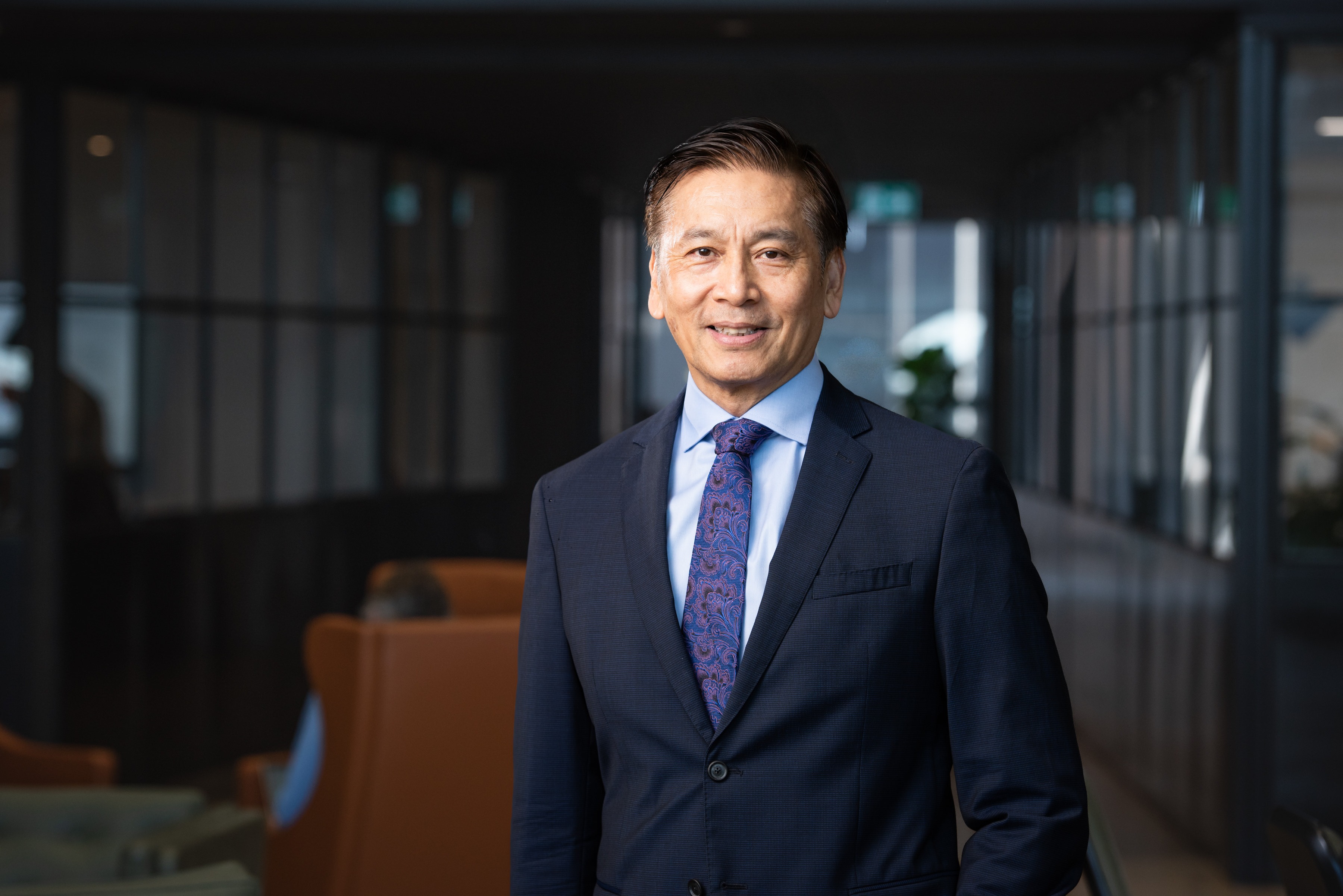
UOB’s broader franchise provided additional support through regional connectivity and transaction banking, which represented close to half of wholesale banking income and benefited from higher trade activity. CEO Wee Ee Cheong said UOB was seeing “healthy trade and investment flows, stronger connectivity with Greater China and ongoing supply chain shift into the region”, adding that “ASEAN is our home ground, our competitive advantage and our engine of growth”.
DBS reported pre-tax profit up around 5.7% to SGD 7.2 billion ($5.6 billion) and ROE of 18%, the highest of the three, on record net fee income of SGD 2.9 billion ($2.3 billion), up 20%, which accounted for around 24% of total income. Non-interest income contributed around 41% of total income, reflecting strong activity across wealth, transaction services, treasury and markets.
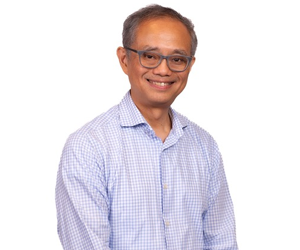
Loan growth of 8% also supported earnings. Group NIM declined 20 basis points to 1.88% from 2.08%. A 34% decline in allowances also contributed to earnings, while pre-provision operating profit rose around 3%, indicating that lower credit costs remained an important contributor to headline earnings growth. CEO Tan Su Shan said the strength of fee growth reflected broad-based customer activity rather than a single business line, with wealth management, institutional banking and transaction services all contributing.
Fee income is becoming a more important earnings stabiliser, but resilience depends on breadth and recurrence, not the size of any single line. OCBC's advantage came from a wide mix of wealth, customer-flow and lending income; DBS showed the value of franchise-wide fee generation, although lower credit costs also supported headline earnings. UOB showed wealth momentum alone cannot offset weakness elsewhere in the fee base.
The second-half outlook depends on whether margins stabilise, and banks sustain broad-based income growth. With SORA remaining lower and potentially nearing a trough, further NIM compression may moderate. Even so, the first-half results suggest fee income alone is unlikely to fully offset weaker net interest income, particularly where growth is concentrated in more market-sensitive categories such as wealth. Banks will need to deepen customer relationships, expand recurring fee businesses and improve operating leverage to sustain earnings into 2026.






.png)
.webp)







 Google
  LinkedIn