


For years, the prevailing narrative has been that artificial intelligence (AI) would usher in widespread job losses across banking. Yet the evidence so far points to a more nuanced reality. The world's largest banks are serving more customers, processing greater volumes of activity and generating more revenue, while employing broadly the same number of people. AI is proving to be less a tool for replacing workers than one for expanding institutional capacity.
An analysis of 25 of the world's largest banks by assets and region suggests that the industry's transformation is unfolding more gradually than many expected. Rather than triggering wholesale workforce reductions, AI is enabling banks to grow without expanding resources at the same pace.
Aggregate headcount across the 25-bank sample remained broadly stable over the past 14 years, rising from 4.33 million employees in 2011 to 4.35 million in 2025, a net increase of just 0.56%. During that period, banks experienced post-financial crisis restructuring, prolonged low interest rates in Europe, branch rationalisation, the COVID-19 pandemic and, more recently, the emergence of generative AI (GenAI). Despite these structural shifts, the sample does not show evidence of broad-based workforce reduction. Aggregate headcount even increased by 3.2%, from 4.22 million in 2021 to 4.35 million in 2025.
That said, the latest figures may signal that the trend has reached an inflection point as banks began to translate AI investment into workforce redesign. Headcount across the 25 banks declined from 4.36 million in 2024 to 4.35 million in 2025, the first decline since 2021. Several institutions have already outlined plans for deeper reductions. Standard Chartered expects to eliminate around 8,000 back-office and support roles, equivalent to 12% of its global workforce, over the next five years, while HSBC is reportedly considering cutting about 20,000 positions, or roughly 10% of its workforce, over the next three to five years. If similar reductions were replicated across the world's largest banks, the industry could shed between 400,000 and 520,000 jobs by 2030.
History, however, suggests that workforce reductions in banking rarely happen overnight. They have typically been driven by restructuring, process redesign and successive waves of automation rather than abrupt technological displacement. Between 2011 and 2021, 13 banks in the sample reduced full-time employees (FTE) by a median of 14,800. Since 2021, only nine have done so, meaning 16 of the world's largest banks employ more people today than they did before the pandemic.
HSBC illustrates how gradual this process can be. Between 2011 and 2025, it reduced its workforce from 288,316 to 208,720 employees, a decline of nearly 80,000 roles, or 28%, the largest reduction among all banks sampled, while increasing revenue per FTE by 33%. This demonstrates that capacity expansion in banking has historically been achieved through sustained operating-model transformation rather than sudden waves of job cuts.
Biggest revenue lift for leading banks in 14 years
Today, the full-time employee base is already producing substantially more revenue, processing more transactions and covering a wider compliance and control burden than it was a decade and a half ago. Revenue per FTE rose across the great majority of the sample between 2011 and 2021 and in the more recent period from 2021 to 2025.
If headcount has remained broadly stable, where are the gains from AI and digital transformation showing up?
The answer lies in capacity expansion. Across most of the banks in the sample, revenue per FTE has risen significantly from 2011 to 2025. Today's workforce is generating more revenue, processing higher transaction volumes and managing a far greater compliance burden than it did over the past 14 years.
North America and China led the first wave of capacity expansion
The first decade after the Global Financial Crisis produced the strongest capacity enhancement, particularly among banks in North America and China. While North American institutions benefited from a faster recovery than many of their European peers, Chinese banks expanded rapidly beyond their traditional corporate and commercial banking franchises into retail banking. Supported by digital infrastructure that now enables more than 90% of retail products to be sold online, they dramatically increased customer reach without expanding headcount at the same pace.
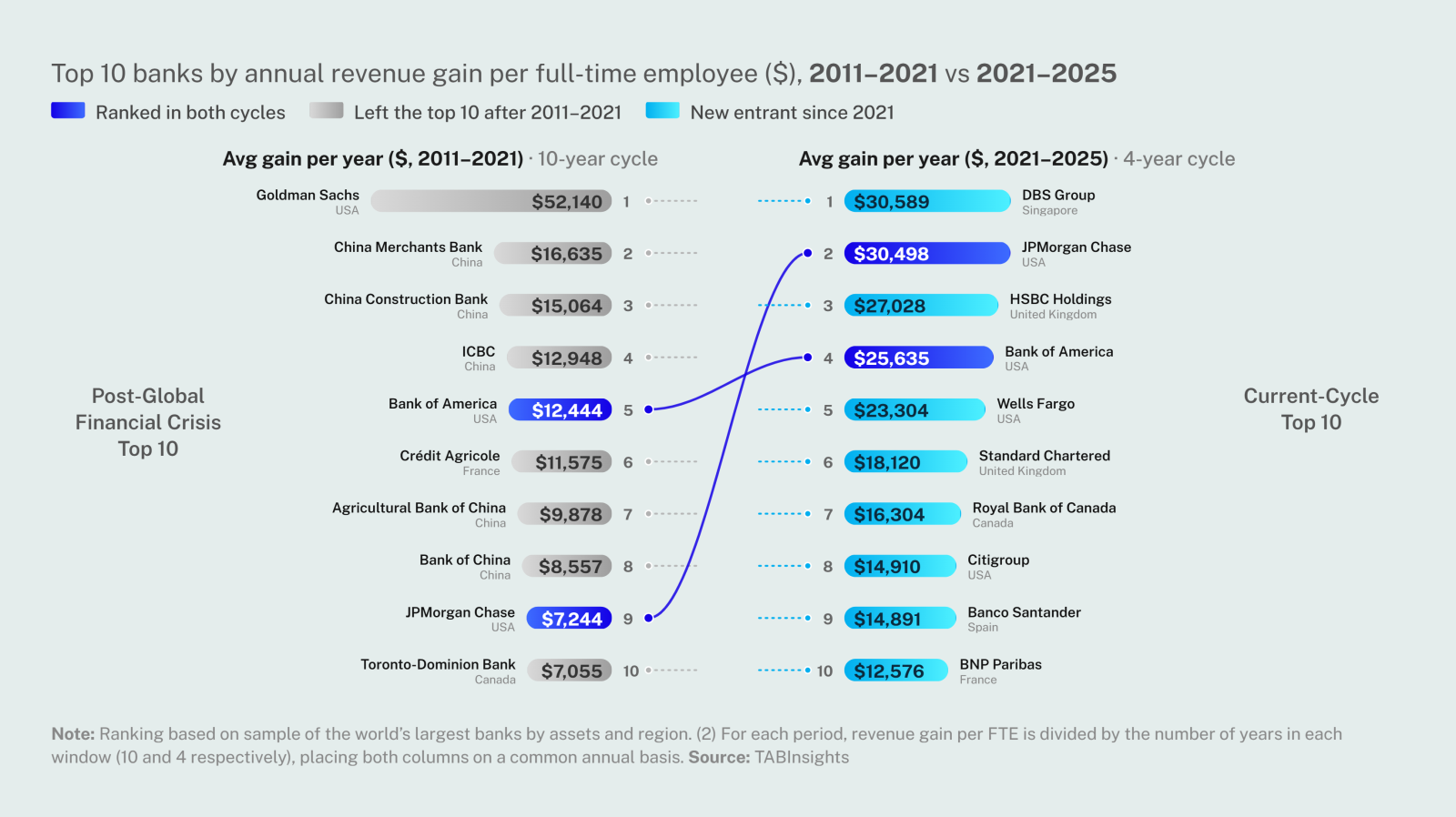
Goldman Sachs exemplifies this trend. Between 2011 and 2021, revenue per FTE increased from $833,300 to $1.35 million, an improvement of more than $521,000 per FTE. Although the firm's workforce grew from 34,700 to 43,900 during the period, its relatively lean operating model meant that growth in trading, asset and wealth management and platform solutions translated into outsized gains in capacity. This was particularly visible in businesses driven by capital markets and asset management, where revenues can scale more readily than in labour-intensive retail and transaction banking.
Growth doesn't require a smaller workforce
Between 2021 and 2025, the leading banks looked markedly different. European banks featured more prominently in the top 10, while Singapore’s DBS Group demonstrated that capacity increase and workforce expansion can go hand in hand. Together with JPMorgan Chase, DBS recorded one of the strongest improvements in revenue per employee, about $122,000 per FTE since 2021, even as both banks continued to increase headcount. Their performance suggests that recent growth in capacity has been driven primarily by stronger revenue growth rather than workforce rationalisation.
Bank CEOs see AI as a capacity expansion tool
For now, most bank chief executives frame AI as a means of enhancing capacity, not as a tool for workforce reduction. Rather than replacing employees outright, banks are using AI to automate routine work, allowing staff to focus on higher-value activities such as advisory, relationship management and complex decision-making.
This approach reflects more than caution. Banking remains one of the world's most heavily regulated industries, where accountability, customer trust and regulatory oversight continue to depend on human judgment. Political sensitivity around job displacement, legacy technology environments and evolving regulatory expectations have also tempered the pace of workforce transformation. As a result, many institutions continue to invest in areas where human relationships remain central to growth, particularly wealth and private banking.
JPMorgan Chase illustrates this balance. Even as it has become one of the industry's largest investors in AI and automation, the bank expanded its wealth management advisory force from about 7,000 advisers in 2020 to 10,000 in 2025, a roughly 50% increase.
DBS has adopted a similar strategy. The bank plans to open 18 new wealth centres across Asia by the end of 2027 while upgrading another 36 centres across Singapore, Hong Kong, mainland China, India, Indonesia and Taiwan. It has explicitly linked this expansion to deeper engagement with affluent and high-net-worth clients.
DBS CEO Tan Su Shan has been equally clear about the bank's long-term direction. AI, she said, will reshape white-collar work, but its immediate role is to strengthen collaboration between people and intelligent systems. DBS is retraining engineers, relationship managers, call-centre staff and operations teams so they can work alongside AI agents while moving into higher-value roles.
The ambition is not to build a leaner bank but a larger, more capable one without a corresponding increase in headcount. DBS's own workforce reflects that strategy. Headcount grew from 17,652 employees in 2011 to 32,833 in 2021, peaking at 41,354 in 2024 before easing to 39,721 in 2025, the first decline since 2021. The modest reduction suggests that even institutions at the forefront of AI adoption are redesigning their workforces gradually rather than pursuing rapid downsizing.
Converting capacity expansion into durable advantage
The experience of leading banks raises a more important question than how many jobs AI might eliminate. The real challenge is how banks can convert higher capacity into lasting competitive advantage without weakening the governance, control and talent pipelines that underpin long-term performance.
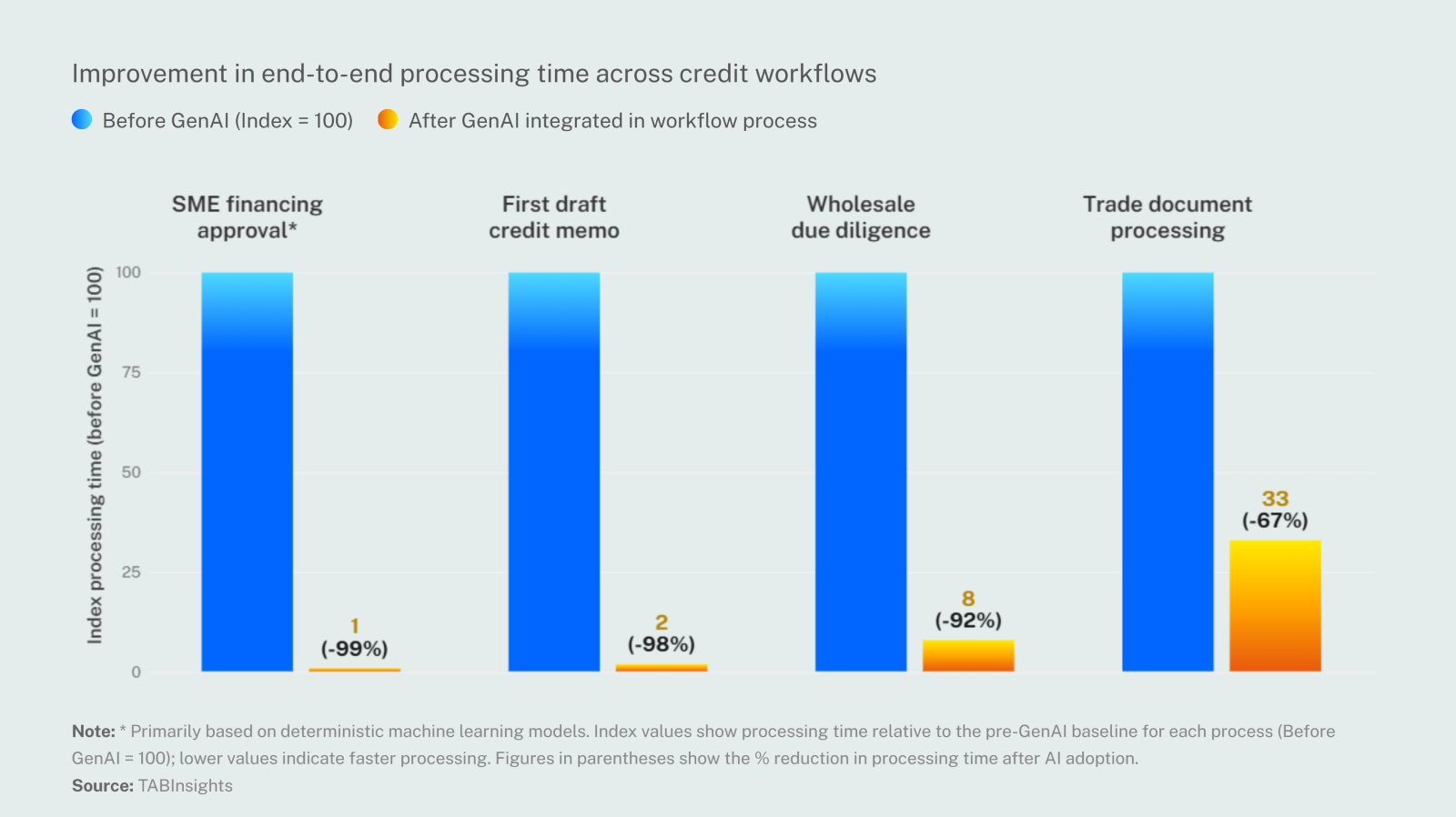
A useful way to understand the impact of AI on banking is through the distinction between weak-bundle and strong-bundle roles. Weak-bundle roles are built around discrete, repeatable tasks such as reconciling accounts, checking KYC documents, preparing first-draft credit memos, compiling regulatory returns or handling routine customer enquiries. These tasks are highly structured, making them well suited to automation. Strong-bundle roles, by contrast, combine technical expertise with relationship management, commercial judgment and regulatory accountability, capabilities that remain far harder to replicate with AI.
This difference helps explain why AI's impact is likely to unfold in stages. Banks first automate routine tasks, then redesign workflows around those capabilities. Only later will they begin to reshape entire job structures. The earliest signs of change are therefore likely to appear through changes in hiring demand than large scale displacement.
Banking ranks among the industries most exposed to AI because so much of its work revolves around text and data, from drafting credit papers and summarising regulatory filings to initiating payments, monitoring transactions and reconciling ledgers. Yet history from the rise of the Internet suggests that automating tasks does not automatically reduce employment. What matters just as much is customer demand, regulatory requirements and how organisations redesign jobs around the technology.
New jobs will emerge as old ones evolve
Every major technology shift creates new forms of work alongside those it displaces. The Internet generated demand for occupations that barely existed three decades ago, including cybersecurity specialists, cloud infrastructure engineers and information security analysts. AI is likely to follow a similar path in banking.
Many of the fastest-growing roles will revolve around governing AI rather than building it. Banks are likely to recruit more model-risk validators, AI governance specialists, data lineage and quality experts, AI auditors embedded within business lines, and professionals responsible for overseeing third-party AI providers. Few of these roles feature prominently on organisation charts today, but they are poised to become an increasingly important source of future hiring.
The first workforce adjustments are already becoming visible. Hiring has slowed for administrative support, junior analysts and staff in operations, credit processing and transaction processing, where AI can take over repetitive work most readily. At the same time, senior bankers are benefiting from those same capabilities. As routine tasks are automated, relationship managers, credit committees and senior executives can devote more time to judgment, client engagement and complex decision-making. For now, the pressure is concentrated at the bottom of the organisational pyramid, even as expectations for higher capacity rise across all levels.
That pattern, however, should not be mistaken for the end state. Today's AI systems largely automate individual tasks. Tomorrow's agentic systems will be capable of managing multi-step processes over extended periods, potentially reshaping work performed by associates, vice-presidents and other mid-level professionals. Their roles may evolve from executing work to supervising, validating and directing AI-generated outputs. Banks that assume only back-office functions are exposed risk underestimating the longer-term implications of the technology.
Erosion of the talent pipeline is the biggest long-term risk
Regulation is likely to slow this workforce transition. Banking, after all, operates within some of the world's most demanding accountability frameworks. Even as AI systems become more capable, responsibility for critical decisions continues to rest with human professionals. That requirement is unlikely to disappear quickly, acting as a natural brake on automation in areas such as credit approval, compliance and financial advice.
The most underestimated risk to the industry in the long-term is the erosion of the talent pipeline. If banks shrink their intake of junior analysts, credit officers and compliance professionals in pursuit of short-term increase in capacity, they also narrow the pipeline from which tomorrow's senior leaders will emerge. The more sustainable response is not simply to reduce entry-level hiring, but to redesign it, combining smaller, more focused cohorts with structured AI-assisted training and expanding career paths in emerging disciplines such as model validation, AI governance, data management and AI-specific operational risk.
Banking's workforce is not being replaced overnight. It is being rewired gradually, unevenly and with purpose. AI, automation and operating-model redesign will continue to increase institutional capacity, enabling banks to serve more customers, process more transactions, strengthen advisory capabilities and meet growing regulatory demands with greater efficiency. The institutions that succeed will be those that redesign work thoughtfully, balancing higher capacity with human judgment, governance and the development of future talent.
Subscribe for regular insights.


Banner.png)


.png)






 Google
  LinkedIn