

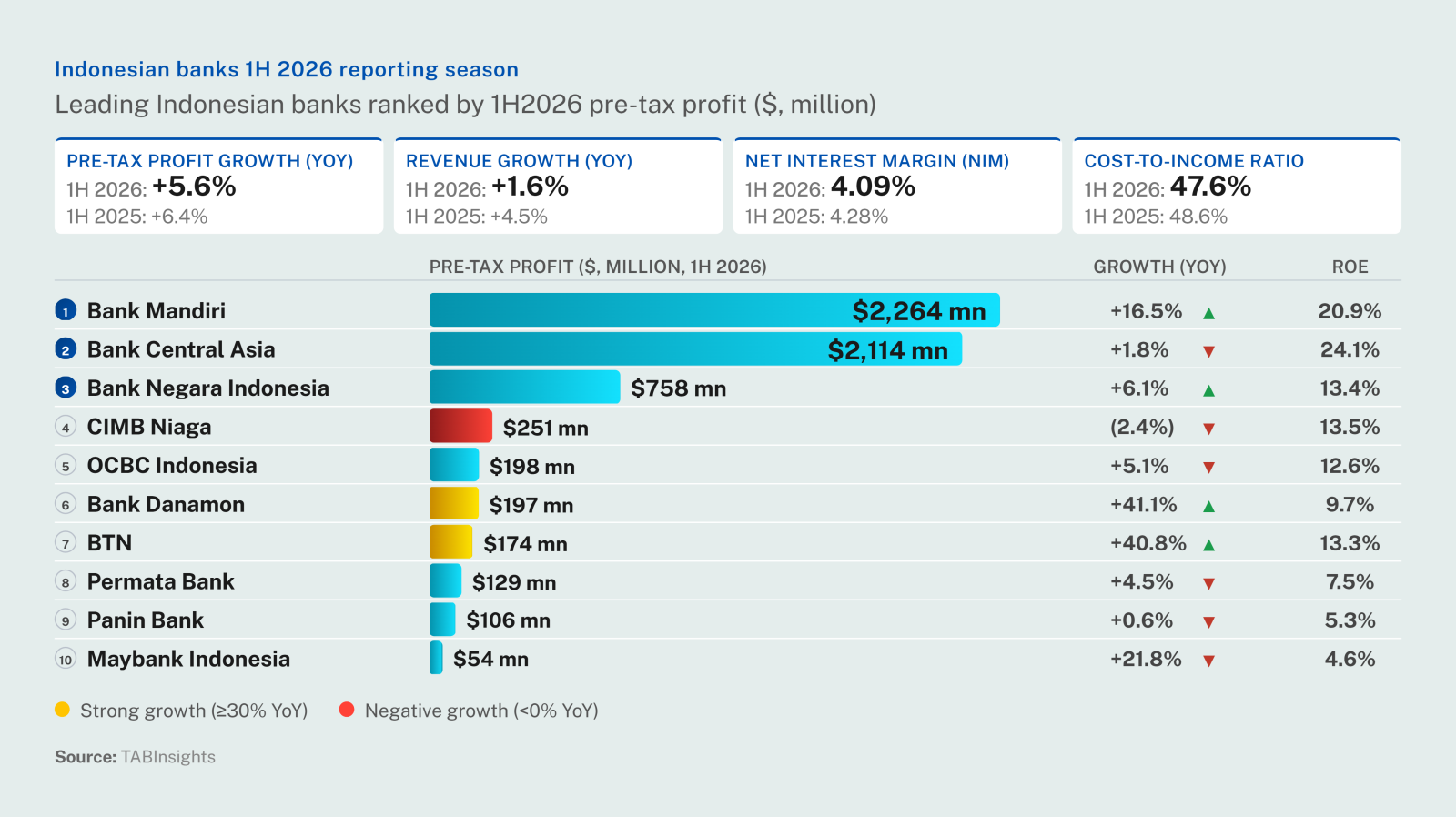

Industry pre-tax profit growth slowed to 5.59% year-on-year (YoY) in the first half of 2026 (1H2026), from 6.42% a year earlier. The 10 leading banks reported combined pre-tax profit of IDR 107.7 trillion ($6.2 billion), up 9.3% from a comparable IDR 98.5 trillion ($5.7 billion).
The improvement in profit was not matched by stronger operating performance. Combined revenue grew just 1.6% to IDR 204 trillion ($11.8 billion), while the simple average net interest margin (NIM) across the group contracted by 24 basis points to 4.09%. Earnings growth therefore depended increasingly on credit costs, expense discipline and balance-sheet scale rather than stronger revenue or wider margins.
Diverging credit costs became an important differentiator in 1H2026. Six of the 10 banks reduced provisions, while four increased them. Lower charges at several larger lenders helped offset pressure from weaker margins, while higher provisions elsewhere absorbed much of the benefit from revenue and loan growth.
The operating environment also became less supportive. Bank Indonesia raised the BI-Rate by a cumulative 100 basis points between May and June to 5.75% as it sought to stabilise the rupiah. By June, system-wide credit was expanding 12.67% YoY, ahead of deposit growth of 10.21%, increasing competition for funding even though sector liquidity remained above regulatory minimums.
This created an uneven earnings environment. Banks able to combine scale with lower credit costs and tighter expense management continued to increase profits despite margin compression, while lenders facing additional provisioning found it harder to translate operating growth into higher earnings.
Bank Mandiri was among the stronger performers in 1H2026, with pre-tax profit rising 16.5% YoY to IDR 39 trillion ($2.3 billion) despite revenue slipping 0.7% and NIM narrowing to 4.6% in 1H2026 from 4.9% in 1H2025. The divergence suggests that earnings growth was driven less by stronger income generation than by improvements elsewhere in the P&L.
Provisions fell 12.5%, while the cost-to-income ratio improved sharply to 36.5% from 44.4%. Riduan, president director of Bank Mandiri, said the second half of 2026 would “largely be about interest-rate dynamics”, with higher rates also affecting liquidity. The results show how efficiency and lower credit costs helped Mandiri absorb weaker revenue and margin pressure, although tighter funding conditions could make that support harder to sustain.
CIMB Niaga presented the clearest counterpoint, with pre-tax profit falling 2.4% YoY to IDR 4.3 trillion ($0.25 billion) despite revenue growth of 7%. NIM also narrowed to 3.84% in 1H2026 from 3.96% in 1H2025, showing that stronger top-line growth was not enough to fully offset pressure on profitability.
The bigger drag came from credit costs. Provisions rose 60.2%, absorbing much of the benefit from higher revenue and leaving profit lower despite otherwise resilient operating performance. CIMB Niaga’s results underline how quickly higher provisioning can outweigh revenue growth when margins are also under pressure.
Lani Darmawan, president director and chief executive officer of CIMB Niaga, described first-half performance as stable, supported by credit growth and stronger low-cost funding. Gross non-performing loans (NPLs) improved to 1.83%, while additional provisions were concentrated in its multi-finance business to meet regulatory requirements. This suggests that higher credit costs reflected a specific provisioning need rather than broad deterioration in asset quality.
The results highlight a broader challenge for Indonesian banks. Theresia Adriana Widjaja, chief financial officer of Bank Danamon, said profit growth was driven by higher revenue and improved credit quality, with cost of credit falling 12% YoY. Yet with system credit growth continuing to outpace deposits, the cost and availability of funding are becoming increasingly important. Banks with stronger low-cost deposit franchises and tighter cost control should have more room to defend margins as funding costs rise.
Bank Indonesia held the policy rate at 5.75% in July and maintained its 2026 gross domestic product growth projection of 4.9%-5.7% and credit growth projection of 8%-12%. Gross banking-sector NPL improved to 2.09% in June, suggesting that asset quality remains supportive even as higher rates increase pressure on funding costs.
Profit growth is likely to moderate in the second half as funding competition remains elevated and revenue growth stays weak. Banks with stronger low-cost deposit franchises, disciplined credit costs and more diversified fee income should be better placed to protect margins and sustain profitability through the rest of 2026.
Subscribe for regular insights.


Banner.png)



.png)






 Google
  LinkedIn