

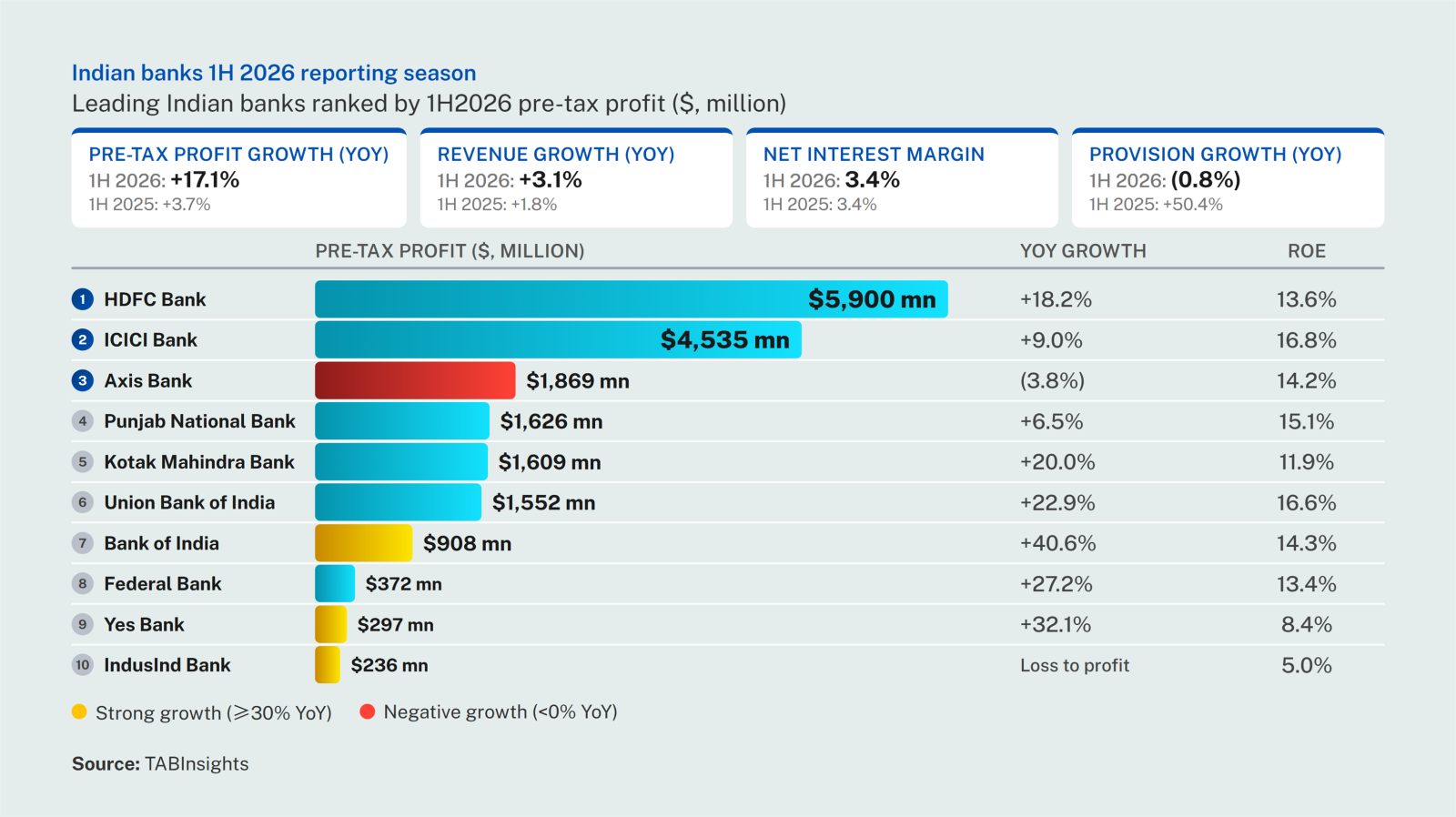

Combined pre-tax profit rose 17% year-on-year (YoY) to INR 1.759 trillion ($18.9 billion) in the first half of 2026, up from INR 1.503 trillion ($16.2 billion) a year earlier. The increase was more than four times the 4% growth recorded in the same period of 2025.
The improvement in pre-tax profit was not matched by stronger operating performance. Combined revenue grew just 3% to INR 3.683 trillion ($38.4 billion), while the average net interest margin remained broadly stable at 3.38%, up only two basis points YoY. This suggests that earnings growth was driven mainly by lower provisions at several large lenders rather than stronger revenue growth or wider margins.
Provision trends varied widely across the group. HDFC Bank and Kotak Mahindra Bank cut provisions by 68% and 44%, respectively, while Punjab National Bank and Federal Bank increased them by 73% and 93%. As some of the largest lenders recorded sharp reductions, the decline in their credit costs had a disproportionate impact on combined profit, even as provisions increased at other banks.
Margin performance was similarly mixed. The Reserve Bank of India kept the policy repo rate unchanged at 5.25% during the first half of 2026 after cutting it by a cumulative 125 basis points between February and December 2025. Floating-rate loan yields adjusted quickly to the lower-rate environment, while deposit costs repriced more gradually and competition for high-quality corporate borrowers remained intense.
This created a two-speed earnings environment. Banks that benefited from lower credit costs continued to report strong profit growth, while those facing margin pressure and higher provisions found it harder to translate balance-sheet growth into higher returns.
HDFC Bank recorded the largest absolute increase in pre-tax profit, adding INR 84.4 billion ($880 million) YoY. Pre-tax profit rose 18% to INR 548.6 billion ($5.9 billion), accounting for about one-third of the group's total increase.
The improvement came despite a 1% decline in revenue, a 16-basis-point contraction in the average net interest margin to 3.84% and an increase in the cost-to-income ratio (CIR) to 42% from 39.3%. Instead, earnings were supported mainly by a 68% reduction in provisions. Srinivasan Vaidyanathan, chief financial officer of HDFC Bank, said lower funding costs had yet to be fully reflected in margins, with further improvement expected as deposits and wholesale borrowings reprice.
HDFC Bank's results show how scale and lower credit costs can offset weaker operating performance. They also expose the limits of this recovery: unless revenue and margins improve, profit growth will become harder to sustain as the benefit of lower provisions fades.
Axis Bank presented the clearest contrast. It was the only bank to report a YoY decline in pre-tax profit, which fell 4% to INR 174.3 billion ($1.9 billion), while IndusInd Bank returned to profit after a loss in the previous year. Axis Bank's revenue rose 2%, but its average first-half net interest margin contracted by 35 basis points to 3.54%, the steepest decline among the banks analysed. At the same time, provisions increased 8% and the CIR rose to 48% from 46%.
Amitabh Chaudhry, managing director and CEO of Axis Bank, described the bank's June-quarter net interest margin of 3.46% as the "cycle bottom", signalling that margins are expected to recover gradually as funding costs reprice. The June-quarter margin was below the bank's 3.54% average for the first half, highlighting the pressure on margins toward the end of the period.
Despite the pressure on profitability, Axis Bank continued to expand its franchise. June-quarter deposits grew 18% YoY and advances increased 19%, while its corporate loan book expanded 38%. Around 91% of the corporate portfolio remained rated A-minus or above, indicating that growth continued to be driven by higher-quality borrowers rather than a shift towards riskier lending.
The results highlight a broader strategic challenge. Balance-sheet growth alone will not protect profitability if lending yields decline faster than funding costs. Banks must therefore evaluate corporate relationships across lending spreads, transaction fees, operating balances and capital usage, while maintaining credit discipline and delivering acceptable risk-adjusted returns.
In the second half of 2026, lower credit costs may continue to support earnings at some large banks, although this benefit is expected to fade as the favourable comparison base normalises. The Reserve Bank of India lowered its growth forecast to 6.6% from 6.9% in June, while keeping the repo rate unchanged at 5.25% and maintaining a neutral stance.
HDFC Bank demonstrates how lower provisions can temporarily offset weak operating momentum, while Axis Bank highlights the pressure from margin compression, higher provisions and weaker efficiency. With 125 basis points of rate cuts already delivered since February 2025, the near-term outlook will depend less on further monetary easing and more on deposit repricing, stronger fee income and cost discipline.
Subscribe for regular insights.


Banner.png)



.png)






 Google
  LinkedIn