
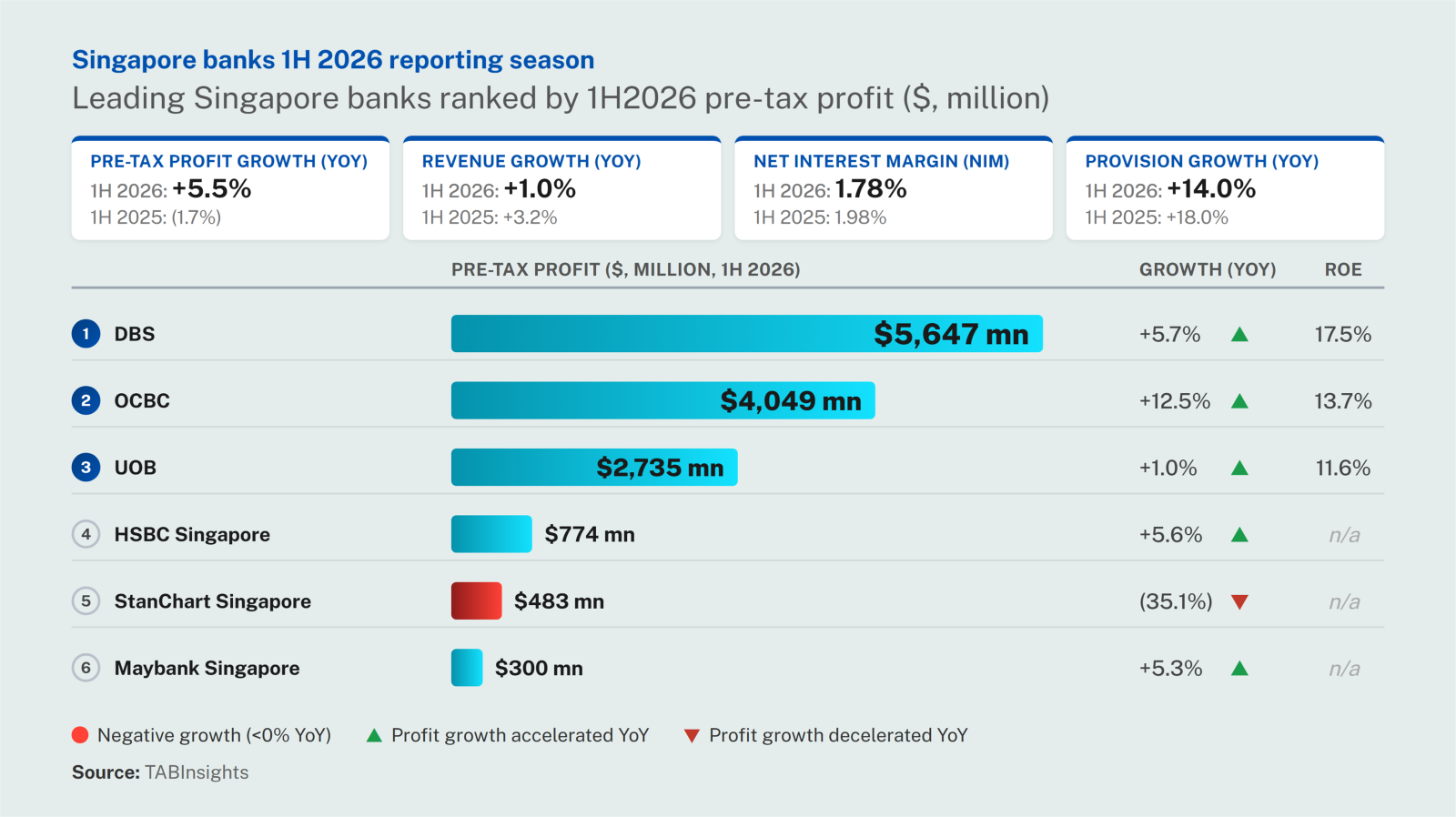

Singapore's banking sector reported combined pre-tax profit of $14 billion in the first half of 2026, up 5% year-on-year (YoY). The increase came despite a lower interest-rate environment, with benchmark rates declining and net interest margins (NIM) narrowing from elevated levels.
The Singapore Overnight Rate Average (SORA) was lower YoY, reducing net interest income even as loan books expanded. The Monetary Authority of Singapore (MAS) tightened policy for a second consecutive review in July 2026, steepening the Singapore dollar's appreciation path. The economy expanded 1.1% quarter-on-quarter in the second quarter after an upwardly revised 1.3% in the first quarter. Against this backdrop, banks with stronger wealth management, transaction banking and other fee-generating businesses were better able to offset weaker lending income, while cost discipline became more important as margins narrowed.
The impact of lower rates varied across banks. DBS's pre-tax profit rose 6% YoY to SGD 5.65 billion ($4.44 billion) despite NIM narrowing to 2.25% from 2.61%, while UOB's rose 1% to SGD 2.74 billion ($2.16 billion) as NIM fell to 1.78% from 1.96%. HSBC Singapore's pre-tax profit rose 6% to $774 million, and Maybank Singapore's rose 5% to $300 million Standard Chartered Singapore's costs rose 17% YoY, pushing its cost-to-income ratio (CIR) to 64% from 52%, even as revenue fell a comparatively modest 4%. The differences reflected banks’ revenue mix, cost structures and ability to absorb margin pressure.
OCBC recorded the strongest earnings growth among Singapore's domestic banks, with pre-tax profit rising 13% YoY to SGD 5.17 billion ($4.0 billion) despite NIM narrowing from 1.98% to 1.73%. Higher fee and wealth management income helped offset margin pressure, while the bank's CIR improved to 35.8% from 36.4% a year earlier. Group CEO Tan Teck Long said the first-half results "reflected strong momentum across our diversified franchise", with wealth management income reaching a record level. The results showed how fee diversification helped offset margin pressure from lower rates and support earnings.
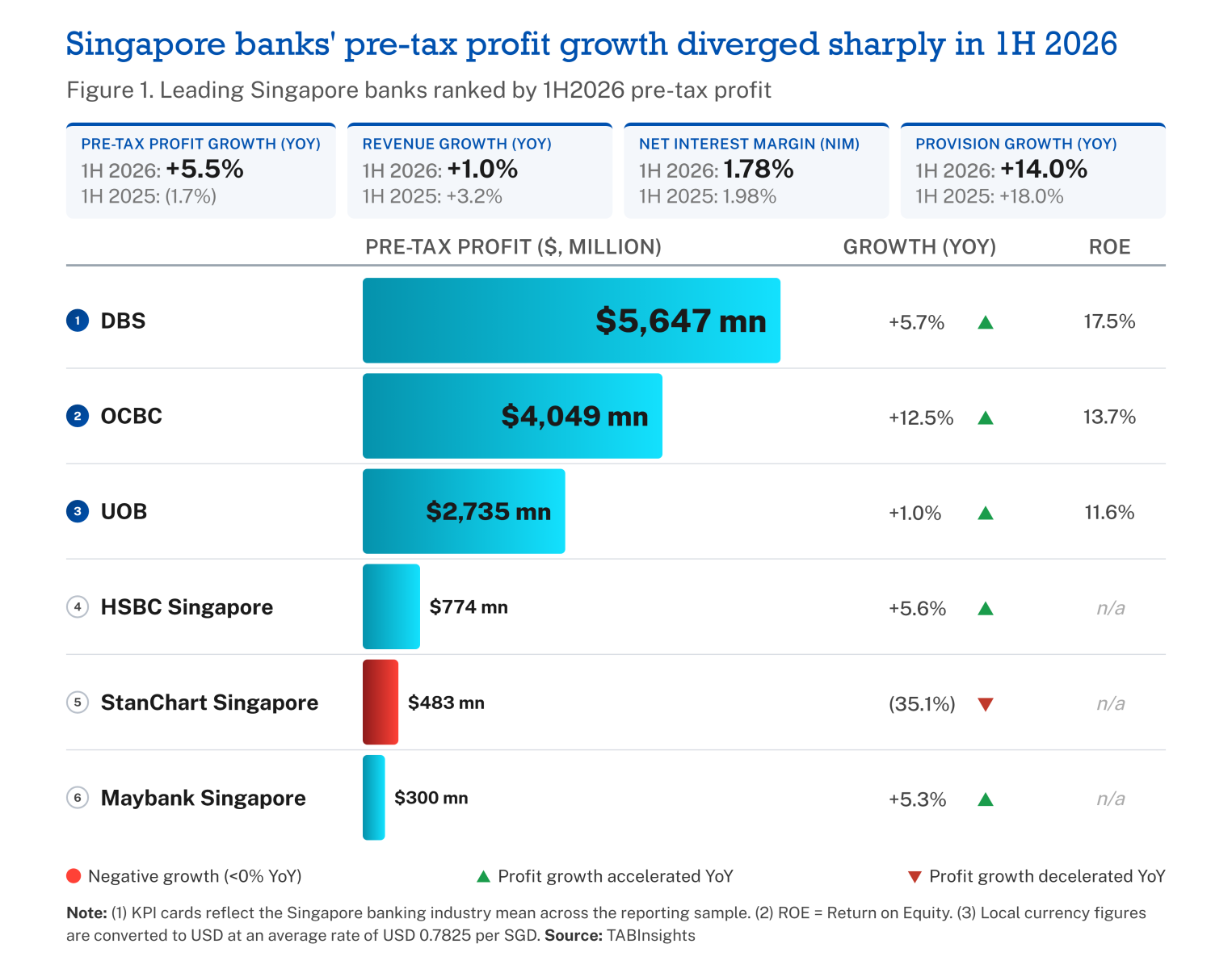
UOB reported slower earnings growth among the three domestic banks, with pre-tax profit rising 1% YoY to SGD 3.50 billion ($2.7 billion). NIM declined to 1.78% from 1.96% as lower interest rates reduced lending margins, although wealth management and transaction banking income provided support. Group CEO Wee Ee Cheong said the results "reflect the resilience of our diversified franchise, and the momentum building across our key ASEAN markets". UOB's performance showed how diversified income streams helped preserve earnings resilience as lower margins weighed on traditional lending businesses.
Beyond revenue diversification, credit costs also became an important differentiator across the sector. DBS reduced provisions by 34% YoY, while UOB and OCBC increased provisions by 14%, reflecting different credit-cost trends across banks. DBS CEO Tan Su Shan said the bank had navigated the environment through "proactive balance sheet management", highlighting the importance of maintaining resilience as interest-rate support faded. As margins normalise, banks will need to sustain fee income growth while managing costs and credit risk in the second half.
Into the second half of 2026, the sector's earnings outlook will depend on whether non-interest income can continue to offset pressure on lending margins as banks adjust to lower rates. DBS raised its full-year guidance, expecting total income to exceed 2025 levels, while UOB's guidance for a full-year NIM of 1.75% to 1.80% points to a stabilisation in margins rather than further significant deterioration.
The divergence in guidance highlights that earnings resilience will increasingly depend on banks' ability to balance revenue growth with margin management and cost discipline. As the sector moves beyond the benefits of elevated interest rates, profitability will depend on sustained income growth and effective execution across business lines.






.png)
.webp)







 Google
  LinkedIn