
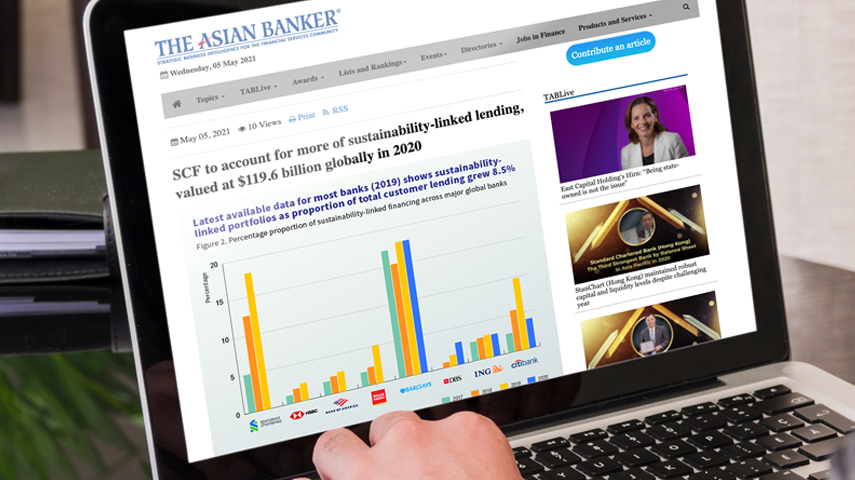
As demand for sustainable products rises, stakeholders including consumers, investors, and regulators are pushing manufacturers, suppliers and lenders to incorporate ESG metrics in evaluating the performance of their supply chains.
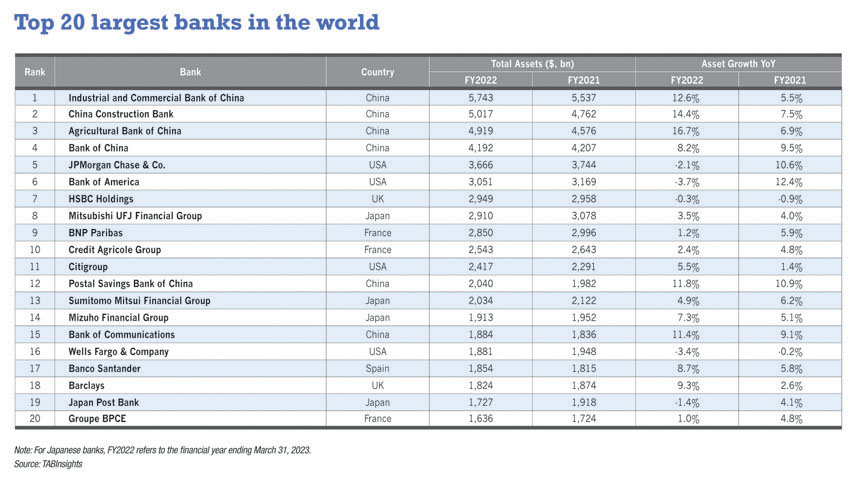
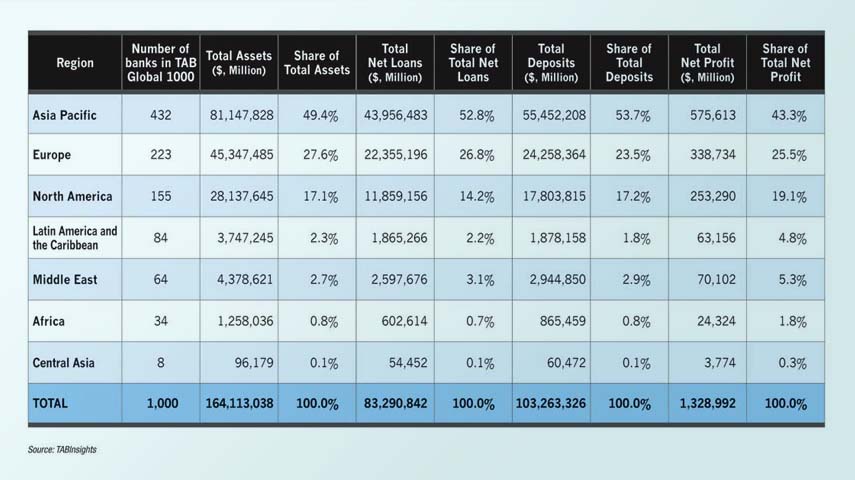
Thirty-seven banks held assets surpassing $1 trillion, distributed among 16 in Asia Pacific, 13 in Europe, and eight in North America, representing 51% of the top 1000 banks’ total assets; overall asset growth has decelerated, with the US and some European nations experiencing steep declines and countries like Egypt demonstrating resilience

Overall balance sheet growth in Asia Pacific and North America slowed amid weak credit demand, cautious lending and regulatory prudence, while European banks rebounded modestly and Middle Eastern banks saw accelerated expansion, fueled by government-backed investment projects.
A correlation analysis across 100 global retail banks in FY25 finds a weak but statistically significant negative relationship between asset size and return on assets. Regional leaders demonstrate that specific business model choices, not balance sheet scale, drive superior profitability.
An analysis of AI initiatives across 29 Global Systemically Important Banks (G-SIBs) from 2023 to 2025 reveals a sector in structural transition: from experimentation to scaled enterprise execution, from point solutions to platform architectures, and from model access to data control and insights as the primary source of competitive strength. JPMorgan Chase’s decade-long institutional AI build illustrates what that transition looks like at the world's largest, most interconnected and systemically important banks.