
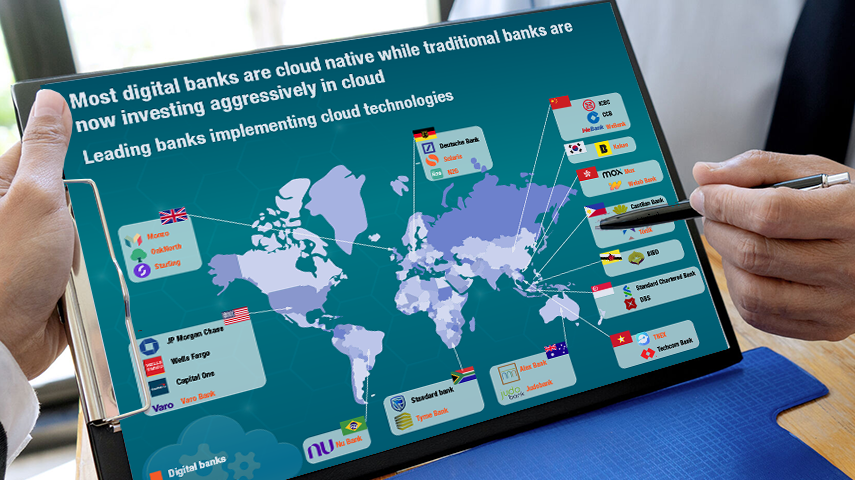
The financial services industry is undergoing a massive shift to cloud, but the challenging technology transition for incumbents requires a strategic rethink of architecture, data, people and processes.


Tech giants, which make up some of the world’s largest companies, are muscling into traditional banking spaces. But whether they want to crush the traditional finance players or enable them, they are learning across the globe that disrupting well-regulated banking systems is easier said than done

The German fintech’s dramatic collapse is likely to reshape the payment processing landscape as market rewards players leading innovation and value creation
Several key themes emerged amidst the many discussions by global leaders in payments, including QR code, blockchain, credit card schemes, fintech and data consolidation
The bank onboarding process should be fast, as the most fundamental attribute of an exceptional account opening experience is speed
Driven by competition and rapid disruption, banks increasingly spend on technology enabled models targeted to improve customer experience and service capability. What are the recent developments and top priorities of banks in 2018?
Tim Berners-Lee, inventor of the World Wide Web, joined the Asian Banker’s Emmanuel Daniel and Gordian Gaeta in a debate on the development of the internet, innovation in China, and what the financial industry can learn from both
Chatbots are another example of relatively low-cost advancements in artificial intelligence adoption within the banking industry. These computer programmes are designed to conduct live chats to resolve common queries and carry out specific tasks; and they are proving to be popular among customers.
Alipay retains its top spot in this year’s ranking, while Apple Pay climbs higher with its expanded financial services ecosystem
South American banks led with the highest average loan-to-deposit ratio at 109%, followed by Europe at 96%, with around 50% of South American and 42% of European banks with ratios exceeding 100%
An analysis of AI initiatives across 29 Global Systemically Important Banks (G-SIBs) from 2023 to 2025 reveals a sector in structural transition: from experimentation to scaled enterprise execution, from point solutions to platform architectures, and from model access to data control and insights as the primary source of competitive strength. JPMorgan Chase’s decade-long institutional AI build illustrates what that transition looks like at the world's largest, most interconnected and systemically important banks.